Introduction
In the hospitality industry, every guest enquiry can represent a potential booking.
A visitor comes to a hotel’s website because they are interested in staying at the property. They may want to know about room availability, pricing, facilities, check-in and check-out timings, parking, dining options, banquet facilities or other services.
But there is one major challenge.
The guest expects an answer immediately.
A hotel team, however, may not always be available to respond immediately. The front desk may be handling check-ins. The reservation team may be speaking with another customer. The sales team may be attending a meeting. The hotel may receive an enquiry late at night when the relevant team is unavailable.
The visitor may wait for some time, leave the website and contact another property.
This creates a simple but important business problem:
The hotel received an enquiry, but the opportunity was not captured.
This is where artificial intelligence can provide practical value.
Instead of allowing every website visitor to become a missed opportunity, an AI-powered conversational assistant can provide an immediate first response, understand the visitor’s requirement, collect relevant information and help connect the enquiry with the appropriate hotel team.
For hospitality businesses, the objective is not to replace the front desk, reservations team or sales staff.
The objective is much simpler:
Make sure a guest enquiry receives a response even when the human team is busy or unavailable.
Livserv AI can help hospitality businesses create this first layer of digital communication and make their websites more responsive to potential guests.
The Single Problem: Missed and Delayed Guest Enquiries
Imagine a potential guest searching for a hotel for an upcoming weekend.
They find a hotel website and have a few questions:
“Do you have rooms available?”
“What is the tariff?”
“Is breakfast included?”
“Do you have parking?”
“Can I check in early?”
“Do you have a banquet hall for 200 people?”
The visitor may not immediately make a phone call.
Instead, they may look for a chat option on the website.
If there is no immediate assistance, the visitor may leave.
Even when a contact form is available, the visitor may not want to submit a form and wait several hours for a response.
The problem is particularly important because the visitor has already shown interest.
They are not simply browsing random information.
They may be actively considering a hotel.
Therefore, every unanswered or delayed enquiry can represent a missed opportunity for the business.
Why Speed Matters in Hotel Enquiries
Hospitality customers often compare multiple properties before making a decision.
A potential guest may have five hotel websites open at the same time.
They may compare:
Room prices
Location
Amenities
Reviews
Availability
Dining options
Event facilities
Parking
Offers
Customer service
Communication can become another factor in the decision-making process.
If Hotel A responds immediately while Hotel B responds several hours later, the visitor may continue communicating with Hotel A.
This does not mean that every instant response will result in a booking.
However, an immediate response gives the hotel an opportunity to continue the conversation.
That is the important difference.
Without immediate communication:
Visitor → Question → No response → Website exit
With AI-assisted communication:
Visitor → Question → Immediate response → Requirement captured → Hotel team follow-up
The second journey gives the business another opportunity to engage with the potential guest.
Why Hotel Staff Cannot Answer Every Enquiry Immediately
Hotel employees already manage multiple responsibilities.
A front-desk executive may simultaneously handle:
Guest check-in
Guest check-out
Room requests
Phone calls
Billing questions
Internal coordination
Walk-in customers
A reservation executive may be handling:
Booking requests
Cancellation requests
Modification requests
Group enquiries
Corporate bookings
Telephone enquiries
A sales executive may be handling:
Corporate clients
Wedding enquiries
Conference enquiries
Banquet bookings
Site visits
Follow-ups
Therefore, expecting employees to respond instantly to every website visitor can be difficult.
The challenge is not necessarily a lack of staff effort.
It is the volume and timing of enquiries.
A hotel can have excellent employees and still miss enquiries simply because the right person was unavailable at the right moment.
This is where AI can provide support.
What if the Enquiry Arrives at Midnight?
Consider a simple example.
A guest is planning a trip and searches for accommodation at 11:45 PM.
They visit a hotel’s website.
They want to ask:
“Do you have a family room for four people?”
The reservation team has already finished its working hours.
The guest may have two choices:
Wait until the next day.
Search for another hotel.
The second option is a real possibility.
An AI-powered website assistant can provide an immediate first response.
For example:
Guest:
I need a room for two adults and two children.
Livserv AI:
We’d be happy to help with your enquiry. Please share your preferred check-in date and check-out date, along with your contact number. Our reservation team can assist you with the available options.
The conversation has now started.
The hotel has not lost the opportunity simply because the reservation team was unavailable at that moment.
Livserv AI as the First Point of Guest Communication
Livserv AI can act as a digital first point of contact for hospitality websites.
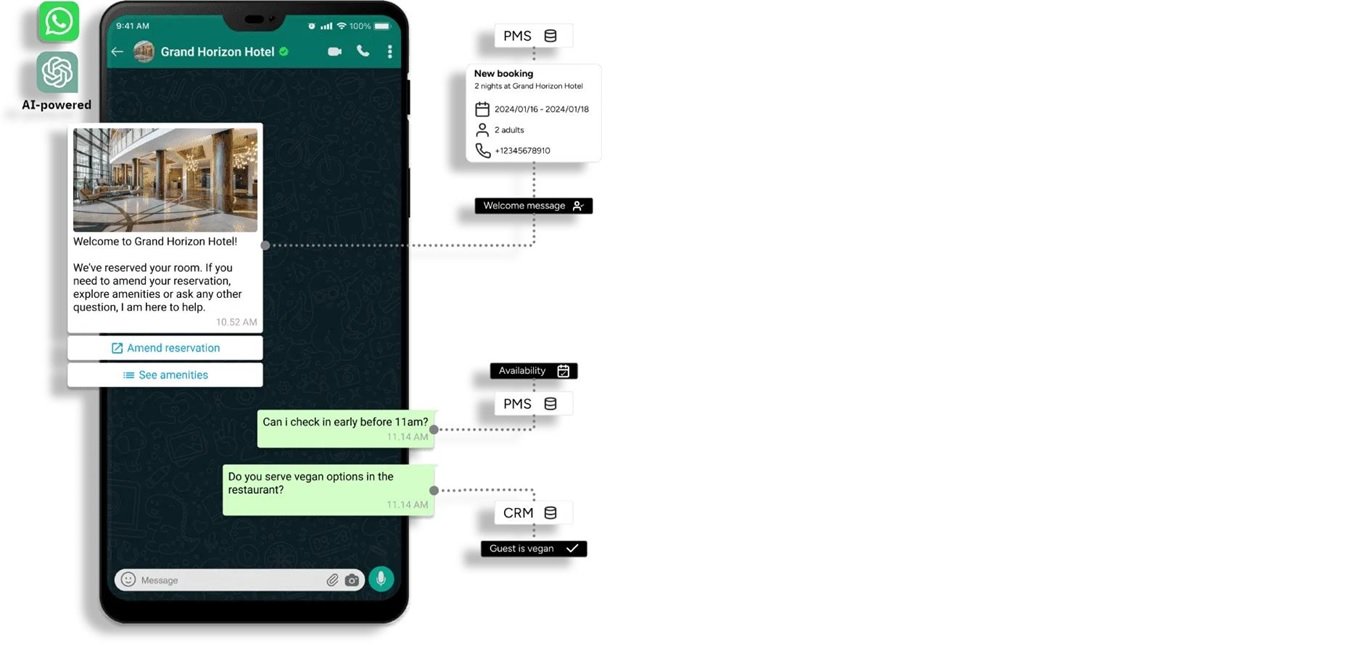
When a visitor opens the website chat, the AI assistant can welcome the visitor and help them find relevant information.
Instead of simply displaying:
“Contact Us”
the hotel website can provide an interactive conversation.
For example:
Welcome! How can we help you today?
• Room Enquiry
• Banquet & Events
• Hotel Facilities
• Restaurant
• General Enquiry
The visitor can select an option or type their question.
This makes the website more interactive.
More importantly, it gives the hotel an opportunity to understand why the visitor has arrived.
From Website Visitor to Qualified Enquiry
Not every website visitor is ready to book immediately.
Some visitors are still researching.
They may ask several questions before deciding.
This is where conversational AI can be useful.
Suppose a visitor asks:
“I am planning a wedding for around 300 guests. Do you have a banquet hall?”
Instead of giving a generic response, the AI can guide the conversation.
It can ask:
What is your preferred event date?
Then:
Approximately how many guests are expected?
Then:
What type of event are you planning?
Then:
Please share your contact number so our events team can assist you.
The conversation has now transformed from a general website visit into a structured enquiry.
The hotel team receives more useful information for follow-up.
The Importance of Lead Capture
Answering a question is useful.
But for a hospitality business, capturing the enquiry can be even more important.
Imagine 100 visitors interacting with a hotel website.
Some may only be looking for information.
Others may have genuine booking intent.
If the website simply provides static information, the hotel may have no way of knowing who was interested.
An AI conversation can provide an opportunity to collect relevant details from visitors who want further assistance.
Depending on the business requirement, information can include:
Name
Contact number
Email address
Check-in date
Check-out date
Number of guests
Room requirement
Event date
Event type
Approximate guest count
Specific requirement
The exact information collected can be designed according to the hospitality business’s workflow.
This means the AI is not simply answering questions.
It can help create a structured lead for the human team.
A Practical Example: Hotel Room Enquiry
Consider this conversation.
Guest:
Hi, I am looking for a room next weekend.
Livserv AI:
Certainly. Please share your preferred check-in and check-out dates.
Guest:
Friday to Sunday.
Livserv AI:
Thank you. How many adults and children will be staying?
Guest:
Two adults and one child.
Livserv AI:
Thank you. Please share your contact number so our reservation team can assist you with the available room options.
The hotel now has:
Guest requirement + dates + occupancy + contact information
The reservation team can follow up with the visitor.
This is more useful than simply allowing the visitor to leave the website.
AI Does Not Need to Replace Hotel Employees
One of the most important points when discussing AI in hospitality is that AI does not have to replace human employees.
Hospitality is a people-oriented industry.
Guests may need personal attention.
Complex requests may require judgement.
Complaints may require empathy.
Special occasions may require human coordination.
A practical AI model therefore works as a combination:
AI handles the first layer.
Humans handle the situations that require human attention.
For example:
Simple question:
What time is check-in?
AI can answer.
Simple question:
Do you have parking?
AI can answer based on approved hotel information.
Potential booking:
I want to book a room for next Saturday.
AI can collect the initial information and guide the guest.
Complex request:
I have a special requirement and need to speak with someone.
AI can facilitate the handover to the hotel team.
This approach allows technology and employees to work together.
24/7 Availability Is the Key Advantage
A hotel’s website is available 24 hours a day.
The potential customer may also visit 24 hours a day.
But the hotel’s employees may not be available 24 hours a day.
This creates a communication gap.
AI can help reduce that gap.
During business hours
AI can respond to routine questions while employees focus on their current responsibilities.
Outside business hours
AI can provide the first response and collect the information required for follow-up.
During peak periods
AI can handle repetitive questions while staff concentrate on guests who require direct assistance.
The result is a more continuous communication experience.
What Questions Can Livserv AI Handle?
The exact questions depend on the information provided to the AI and the hospitality business’s approved knowledge base.
Typical hotel enquiries can include:
Accommodation
What room categories do you have?
Do you have family rooms?
Do you have connecting rooms?
Facilities
Do you have parking?
Is Wi-Fi available?
Do you have a swimming pool?
Dining
What are the restaurant timings?
Do you provide breakfast?
Policies
What is your check-in time?
What is your check-out time?
Do you allow early check-in?
Events
Do you have a banquet hall?
How many people can the hall accommodate?
Can I enquire about a wedding event?
General enquiries
Where is the hotel located?
How can I contact the reservation team?
The AI should respond based on information approved and maintained by the hospitality business.
Accurate Information Is Essential
AI is only as useful as the information provided to it.
A hospitality business may regularly update:
Room information
Facilities
Pricing
Packages
Restaurant timings
Policies
Event capacity
Services
Contact information
If information changes, the AI knowledge base should also be updated.
For example, suppose a hotel changes its breakfast timing from 7:00 AM–10:00 AM to 7:30 AM–10:30 AM.
The updated information should be reflected in the knowledge source used by the AI.
This helps ensure that guests receive information aligned with the hotel’s current approved details.
For Livserv AI, maintaining a clear and updated knowledge base is therefore an important part of creating a reliable hospitality chatbot experience.
AI Can Help During High-Enquiry Periods
Hotels may experience periods when enquiry volume increases.
For example:
Holiday seasons
Wedding seasons
Long weekends
Festivals
Conferences
Corporate events
Local events
During these periods, reservation and sales teams can become extremely busy.
Website visitors may still expect immediate assistance.
AI can act as an additional communication layer during these high-demand periods.
Instead of every visitor immediately waiting for a staff member, AI can first understand the enquiry.
This helps the human team concentrate on conversations that require direct involvement.
One AI Assistant Can Start Multiple Conversations
A human employee normally handles conversations sequentially.
An AI system can interact with multiple website visitors at the same time.
For example:
Visitor 1:
Room enquiry
Visitor 2:
Banquet enquiry
Visitor 3:
Restaurant question
Visitor 4:
Parking question
Visitor 5:
General hotel enquiry
The AI can provide the appropriate first-level response to each conversation.
This is particularly useful for websites that receive a high volume of enquiries.
The purpose is not to eliminate the human team.
It is to make sure that the first response does not depend entirely on whether an employee happens to be available at that exact moment.
Turning an Enquiry into a Conversation
A traditional hotel website often provides information in a one-way format.
The guest reads the page.
If they have another question, they need to search through another page or contact the hotel.
Conversational AI changes the interaction.
Instead of asking:
“Where can I find the information?”
the visitor can simply ask:
“What do you offer?”
The AI can guide the visitor toward the relevant information.
This can make the website feel more like a digital front desk.
Example: Banquet Enquiry
Consider a wedding venue connected to a hotel.
A potential customer visits the website and types:
“I am looking for a hall for 400 guests.”
The AI can begin the enquiry:
We can help you with your event enquiry. What is your preferred event date?
The customer responds.
The AI asks:
What type of event are you planning?
The customer says:
Wedding reception.
The AI can then collect:
Event date
Guest count
Event type
Contact number
The enquiry can then be made available to the relevant sales or events team.
The AI has helped move the visitor from a general website visit to a qualified business enquiry.
Why This Matters for Hospitality Sales Teams
Sales teams need meaningful leads.
A lead containing only:
“Interested”
does not provide much information.
A lead containing:
Event: Wedding reception
Date: 15 December
Expected guests: 400
Requirement: Banquet hall
Contact: Guest-provided number
is considerably more useful for follow-up.
AI-assisted conversations can therefore help collect context before the sales team begins the conversation.
This can make the follow-up process more organized.
The Guest Should Not Have to Repeat Everything
Another benefit of structured enquiry capture is reducing unnecessary repetition.
Suppose a visitor has already provided:
Name
Event date
Guest count
Requirement
The hotel team should ideally have access to the information collected through the enquiry workflow.
The purpose is to make the transition from AI to human assistance smoother.
The guest should feel that the hotel understands why they contacted the business.
This creates a more connected communication experience.
Livserv AI and the Digital Front Desk
The traditional hotel front desk is responsible for welcoming guests and helping them with information.
The digital front desk serves a similar first-contact purpose online.
A visitor may enter the hotel website from:
Google Search
Online advertisements
Social media
Email campaigns
Direct website visits
Referral links
Instead of seeing only static website content, the visitor can interact with Livserv AI.
The AI can:
Welcome → Understand → Answer → Capture → Connect
This simple sequence is at the heart of AI-powered enquiry management.
The Business Value of Responding to Every Enquiry
The value of AI in this use case is not simply technological.
It is operational.
The business wants to avoid losing potential customers because nobody was available to answer an initial question.
Livserv AI can help hospitality businesses create a process where:
Every visitor has an opportunity to start a conversation.
Every relevant enquiry can be captured.
Every important enquiry can be passed to the appropriate team.
Routine questions can receive immediate responses.
This creates a more systematic approach to digital guest communication.
A Simple Before-and-After Example
Before AI
10:30 PM
Guest visits hotel website.
Guest has a question.
No staff member is available.
Guest leaves.
Result:
Potential enquiry may be lost.
With Livserv AI
10:30 PM
Guest visits hotel website.
Livserv AI welcomes the guest.
Guest asks a question.
AI provides the available information.
Guest wants to make an enquiry.
AI collects the required details.
The enquiry can be routed for human follow-up.
Result:
The hotel has an opportunity to continue the conversation.
The difference is not complicated.
It starts with one simple principle:
Don’t let an interested guest leave without an opportunity to communicate.
How Livserv AI Can Fit Into a Hotel’s Existing Team
Implementation does not have to mean changing the entire customer-service operation.
The AI can operate as an additional communication layer.
Website
Guest visits the hotel website.
↓
Livserv AI
AI welcomes and understands the enquiry.
↓
Knowledge Base
AI provides information based on the approved hotel content.
↓
Lead Capture
If the guest wants further assistance, relevant details can be collected.
↓
Hotel Team
Reservation, sales or customer-service staff can follow up where required.
This keeps the existing human workflow at the centre of the process.
AI simply helps create the first response and organize the enquiry.
What Makes This Different from a Static FAQ Page?
A traditional FAQ page might say:
Check-in: 2:00 PM
Check-out: 12:00 PM
Parking: Available
The guest has to find the relevant information.
An AI assistant allows the guest to ask naturally:
“What time can I check in?”
The AI can respond with the approved information.
The difference is the interaction.
Static website:
Guest searches for information.
Conversational website:
Information responds to the guest.
This is particularly valuable for visitors who do not know exactly where information is located on a website.
The Role of AI in Improving Response Coverage
Hospitality businesses cannot guarantee that an employee will always be available.
But they can create a digital system that provides a first response whenever a visitor arrives.
This creates better response coverage across:
Morning
Afternoon
Evening
Night
Weekends
Holidays
Peak enquiry periods
The AI does not need to solve every problem.
It needs to make sure that the conversation does not simply end because a human employee is temporarily unavailable.
Building a Better Guest Enquiry Experience
A successful hospitality AI implementation should not be about adding technology simply because AI is popular.
It should solve a real business problem.
In this case, the problem is:
Potential guests ask questions, but the hotel cannot always respond immediately.
The solution is:
Use AI to provide a first response, answer approved questions and capture relevant enquiries for human follow-up.
That is a clear and measurable use case.
Why Livserv AI Is Relevant to Hospitality Businesses
Livserv AI can be positioned as an AI-powered communication assistant for businesses that want to improve the way they handle website enquiries.
For hospitality businesses, this means creating a more responsive digital entry point.
Instead of:
Website → Contact Us → Wait
the journey can become:
Website → Livserv AI → Immediate Conversation → Enquiry Capture → Human Follow-Up
This creates a more active customer journey.
A Practical Approach for Hotels
Hotels considering AI-powered enquiry management can start with the questions they receive most frequently.
For example:
Step 1: Identify common enquiries
Review:
Website enquiries
Phone enquiries
WhatsApp conversations
Email enquiries
Front-desk questions
Step 2: Create an approved knowledge base
Organize accurate information about the property.
Step 3: Configure the AI
Teach the AI how to respond to common guest questions.
Step 4: Define lead capture
Identify when the AI should request guest contact information.
Step 5: Define human handover
Decide which enquiries should be transferred to hotel employees.
Step 6: Keep the information updated
Update the knowledge base whenever hotel information changes.
This creates a practical foundation for AI-powered guest communication.
The Future of Hotel Enquiries Is Conversational
Hotel websites are becoming more than digital brochures.
Visitors increasingly expect websites to help them find information quickly and interact with businesses.
For hospitality companies, this creates an opportunity.
Instead of waiting for a customer to find a phone number, make a call and speak to an employee, businesses can provide an immediate digital conversation.
AI can become the first layer of that conversation.
The most valuable outcome is not simply that AI answers a question.
The real value is that the guest remains engaged with the hotel.
Conclusion: Every Enquiry Is an Opportunity
A hotel may invest heavily in its website, advertising, rooms, facilities and customer experience.
But if a potential guest asks a question and does not receive a timely response, the business may lose the opportunity before the conversation even begins.
This is the specific problem that AI-powered enquiry management can address.
Livserv AI can help hospitality businesses create a 24/7 digital first point of contact that can:
Respond to common guest questions
Engage website visitors
Understand their requirements
Capture relevant enquiry information
Support lead generation
Provide information based on an approved knowledge base
Help connect important enquiries with the human team
The objective is not to replace hospitality professionals.
The objective is to make sure that hospitality businesses have a way to respond when their employees are busy or unavailable.
Because a guest who receives an immediate response has an opportunity to continue the conversation.
And a conversation that continues creates an opportunity for the hotel to serve the guest.
Livserv AI: Don’t Let a Guest Enquiry Become a Missed Opportunity.
Give every website visitor an opportunity to ask, interact and connect with your hospitality business—24/7.