Author: livserv

  • WhatsApp AI Chatbot with Human Transfer for Healthcare: Automate Patient Conversations Without Losing the Human Touch

    WhatsApp AI Chatbot with Human Transfer for Healthcare: Automate Patient Conversations Without Losing the Human Touch

    Healthcare businesses receive a constant stream of questions through WhatsApp.

    Patients ask about appointments, doctors, departments, consultation fees, hospital timings, available services, reports, locations, and many other things. At the same time, some conversations are too important or too complex to be handled entirely by automation.

    This creates a common problem.

    If every WhatsApp conversation is handled manually, staff spend hours answering repetitive questions. If everything is handled by a chatbot, patients may become frustrated when they need to speak with a real person.

    A better approach is to combine both.

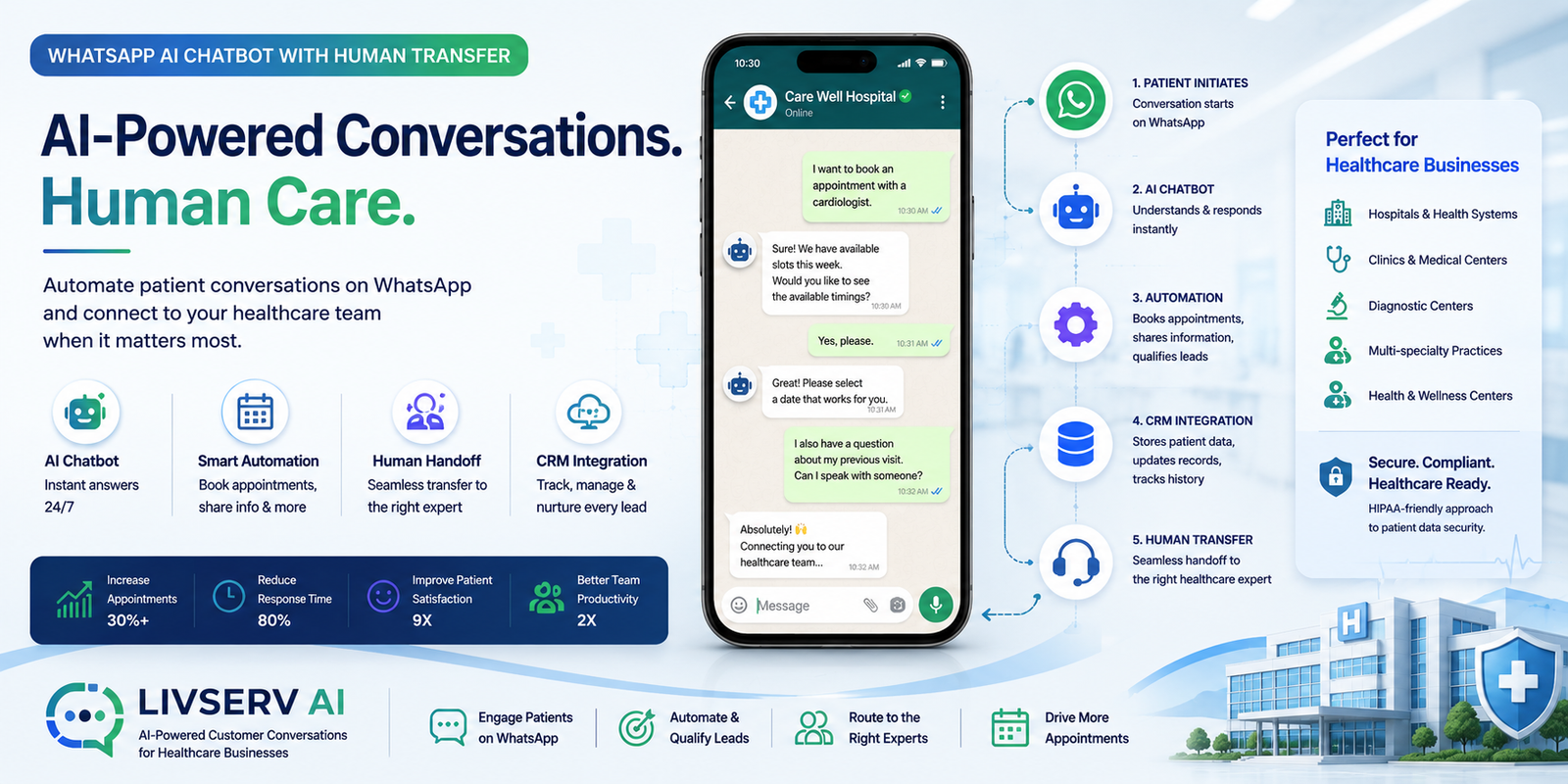
    A WhatsApp AI chatbot with human transfer allows AI to handle routine patient conversations while automatically transferring conversations to the appropriate healthcare representative when human assistance is required.

    The result is a hybrid patient communication system:

    AI Chatbot → Automation → Human Agent

    The chatbot handles the initial conversation. Automation manages routine processes. A human representative takes over when the conversation requires personal assistance.

    What Is a WhatsApp AI Chatbot with Human Transfer?

    A WhatsApp AI chatbot with human transfer is a conversational system that uses AI to communicate with patients through WhatsApp while providing a way to transfer conversations to a human agent.

    Instead of forcing patients to choose between a chatbot and a healthcare representative, businesses can use both.

    For example:

    Patient:
    “I want to book an appointment with a cardiologist.”

    The AI chatbot can understand the request and guide the patient through appointment booking.

    Later, the patient may ask:

    Patient:
    “I have already visited the hospital and have a question about my previous consultation. Can I speak with someone?”

    The chatbot can recognize that the conversation may require human assistance and transfer it to the appropriate representative.

    This is the basic concept behind WhatsApp chatbot human transfer.

    Why Healthcare Businesses Need Human Handoff

    Healthcare communication is different from many other industries.

    Patients may contact hospitals and clinics for simple administrative questions, but they can also have complicated requests that require staff intervention.

    For example:

    • Appointment requests
    • Doctor availability
    • Department information
    • Hospital timings
    • Location information
    • Billing questions
    • Existing patient requests
    • Report-related queries
    • Complaints
    • Service requests
    • Follow-up questions

    Some of these can be automated.

    Others should be handled by trained staff.

    That is why healthcare businesses should not think of AI as a replacement for their employees.

    Instead, AI can become the first layer of patient communication.

    How WhatsApp AI Automation Works for Healthcare

    A typical healthcare WhatsApp workflow can look like this:

    Patient sends WhatsApp message

    AI understands the request

    Chatbot provides information

    Automation performs the required action

    System determines whether human assistance is required

    Conversation is transferred to the appropriate agent

    This allows healthcare organizations to automate repetitive conversations without completely removing human support.

    For example:

    Patient:
    What time does the dermatology department open?”

    The AI can provide the answer.

    Then:

    Patient:
    “I want to book an appointment.”

    The chatbot can guide the patient through the appointment process.

    Then:

    Patient:
    I need to speak to the hospital about an issue with my previous appointment.”

    The system can transfer the conversation to a human representative.

    The patient does not need to start a completely new conversation.

    WhatsApp AI Chatbot vs Traditional WhatsApp Support

    Traditional WhatsApp support usually depends heavily on employees.

    A staff member receives a message, reads it, identifies the patient’s requirement, searches for information, responds, and potentially performs another task manually.

    When message volume increases, response times can increase as well.

    A WhatsApp AI chatbot changes the first stage of that process.

    Traditional process

    Patient → WhatsApp → Staff Member → Find Information → Respond

    AI-assisted process

    Patient → WhatsApp → AI → Answer / Automation → Human Agent When Required

    The second approach allows healthcare employees to spend less time answering repetitive questions.

    What Can a Healthcare WhatsApp AI Chatbot Automate?

    A healthcare chatbot can be used for many administrative and customer-service conversations.

    Appointment Requests

    Patients can initiate appointment conversations through WhatsApp.

    The chatbot can ask for relevant information and guide the patient through the available appointment process.

    Depending on the integrations and workflow configured by the healthcare organization, appointment information can also be connected to calendars, hospital systems, or CRM platforms.

    Doctor Information

    Patients frequently ask:

    • Which doctors are available?
    • Which department should I contact?
    • What specialties are available?
    • When is a particular doctor available?

    The chatbot can provide information from the healthcare organization’s approved knowledge base.

    Department Information

    A patient may ask:

    Do you have a neurology department?”

    The chatbot can provide the relevant information without requiring a staff member to answer manually.

    Hospital Locations

    For healthcare groups operating multiple branches, patients can ask about:

    • Hospital locations
    • Clinic locations
    • Departments
    • Contact information
    • Operating hours
    • General Patient Support

    The chatbot can handle common administrative questions and provide appropriate information.

    The key is that the chatbot should stay within the healthcare organization’s approved information and workflows.

    When Should the Healthcare Chatbot Transfer to a Human?

    The most important part of a WhatsApp AI chatbot with human transfer is knowing when automation should stop.

    Human handoff can be triggered in several ways.

    1. The patient requests a human

    If a patient says:

    “I want to speak to someone.”

    The system should make human assistance available.

    2. The request is outside the chatbot’s capabilities

    If the AI cannot confidently handle a request, transferring the conversation can prevent a poor experience.

    3. The request requires staff intervention

    Certain administrative or operational requests may need to be handled by a hospital employee.

    4. The conversation becomes a complaint

    Patients with complaints or escalations may require direct assistance from a representative.

    5. The patient needs a specific department

    The system can route the conversation to the appropriate team when the workflow supports it.

    6. The business has defined escalation rules

    A healthcare organization can establish specific rules determining which conversations should be transferred.

    AI-to-Human Handoff in Healthcare

    A good AI to human handoff chatbot should make the transition as seamless as possible.

    The biggest mistake is making the patient repeat everything.

    Imagine this conversation:

    Patient:
    “I want to book an appointment with Dr. Sharma.”

    AI:
    “Sure. What date would you prefer?”

    Patient:
    “Tomorrow.”

    AI:
    “Tomorrow is available at 4 PM.”

    Patient:
    “I also need to discuss an issue regarding my previous appointment. Can I speak with someone?”

    The chatbot can initiate a human handoff.

    The healthcare representative should ideally receive the conversation context, where the system supports it.

    The agent can see that the patient was discussing an appointment and requested assistance.

    The agent can then continue the conversation.

    This is much better than:

    “Hello. How can I help you?”

    after the patient has already explained everything.

    WhatsApp Human Transfer for Different Healthcare Teams

    Human handoff becomes even more valuable when healthcare organizations have multiple teams.

    1. A hospital might have separate teams for:
    • Appointments
    • Customer support
    • Billing
    • Insurance
    • Diagnostics
    • General inquiries
    • Patient relations
    • Sales or business
    • development

    The chatbot can identify the patient’s requirement and route the conversation to the appropriate team when the workflow is configured for it.

    For example:

    Appointment request
    → Appointment Team
    Billing question
    → Billing Team
    Insurance question
    → Insurance Team
    Complaint
    → Patient Relations
    Complex inquiry
    → Appropriate Human Representative

    This is more efficient than sending every WhatsApp message to a single employee.

    WhatsApp CRM Agent Routing for Healthcare

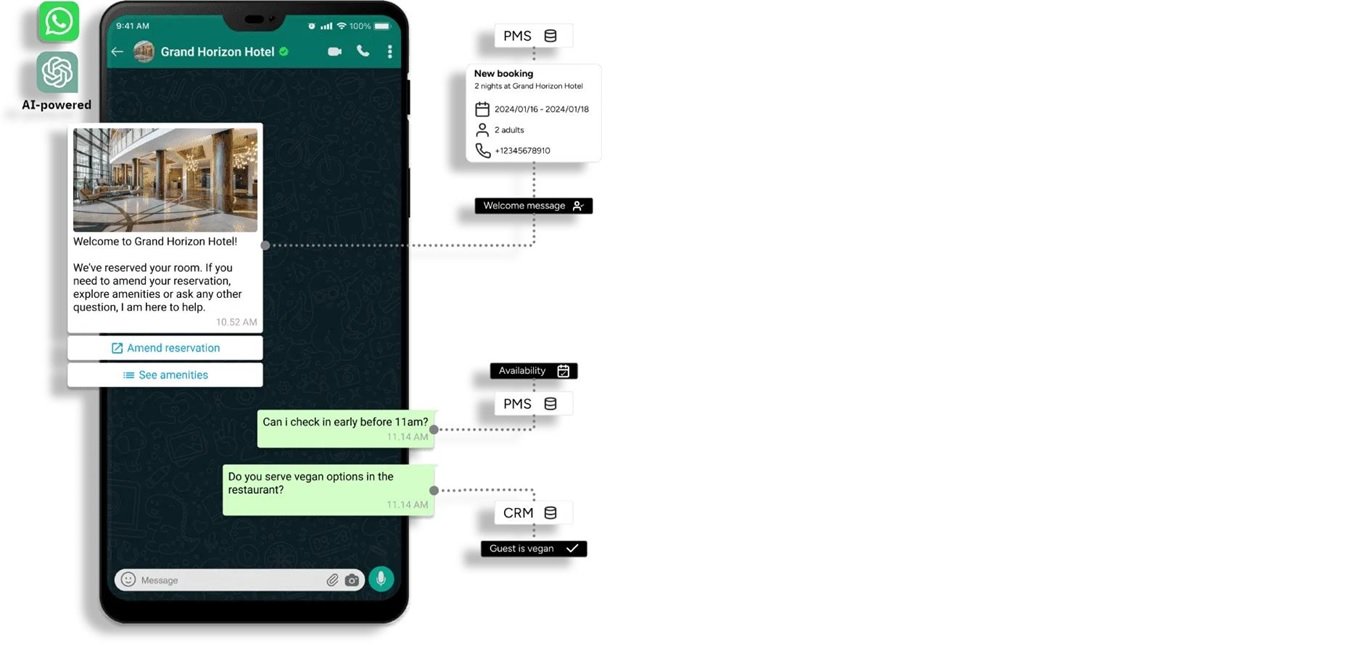
    Connecting WhatsApp conversations with CRM or customer-management systems can provide another layer of automation.

    Instead of treating every WhatsApp conversation as an isolated message, businesses can connect customer information and conversation workflows.

    A typical process can look like:

    WhatsApp

    AI Chatbot

    Identify Customer / Request

    CRM

    Business Rules

    Agent Routing

    Human Representative

    This can help teams manage conversations more systematically.

    For example, if an existing customer contacts the organization, the system may be able to associate the conversation with an existing record when the appropriate integration is available.

    The human representative can then continue the conversation with greater context.

    Rule-Based Automation + AI for Healthcare

    AI is excellent at understanding natural language.

    But healthcare organizations often need predictable workflows.

    This is where a rule-based engine can work alongside AI.

    Consider a patient saying:

    “I want to cancel my appointment.”

    The AI understands the patient’s intent.

    The rule engine can determine what workflow should happen next.

    For example:

    Intent: Appointment Cancellation

    Identify Appointment

    Apply Business Rules

    Cancel / Create Request

    Update System

    Notify Patient

    Transfer to Human if Required

    The AI understands the conversation.

    The rules control the workflow.

    The human handles exceptions.

    This combination creates a more controlled form of conversational automation.

    Why a Hybrid Healthcare Chatbot Is Better

    A purely automated chatbot can become frustrating when it cannot handle an unusual request.

    A purely human support model can become expensive and difficult to scale.

    A hybrid model combines both.

    AI handles:

    1. Repetitive questions
    2. General information
    3. Patient intent
    4. Common requests
    5. Initial conversations
    6. Automation handles:
    7. Workflows
    8. Routing
    9. CRM updates
    10. Appointment processes
    11. Notifications
    12. Business rules
    13. Human agents handle:
    14. Complex requests
    15. Complaints
    16. Exceptions
    17. Requests requiring staff intervention

    This gives healthcare businesses a practical model for scaling patient communication.

    How Human Handoff Can Improve Patient Experience

    Patients don’t necessarily care whether the first response comes from AI or a human.

    They care about whether they get the right help quickly.

    A good system should therefore make the transition between AI and humans almost invisible.

    The patient should experience:

    Fast response

    Relevant information

    Easy escalation

    Human assistance when necessary

    This is particularly useful when WhatsApp becomes one of the primary communication channels for the organization.

    Using WhatsApp AI to Generate More Patient Inquiries

    The value of WhatsApp automation isn’t limited to customer support.

    Healthcare businesses can also use conversational automation to make it easier for prospective patients to take the next step.

    For example:

    Visitor sees an advertisement
    Clicks WhatsApp
    AI answers questions
    Patient selects department
    AI provides information
    Patient requests appointment
    Appointment workflow starts
    Human representative takes over if necessary

    This reduces the number of steps between initial interest and an actual conversation with the healthcare organization.

    For marketing campaigns, WhatsApp can therefore become more than a messaging channel.

    It can become a conversation-to-action channel.

    Example: Healthcare Lead Generation Through WhatsApp

    Imagine a hospital running an online campaign for a specialty department.

    A potential patient clicks the campaign and starts a WhatsApp conversation.

    The AI chatbot can respond:

    “Hello. How can we help you today?”

    The patient responds:

    “I want to know about your orthopedic services.”

    The chatbot provides approved information.

    The patient asks:

    “Can I book an appointment?”

    The chatbot guides the patient through the next step.

    If the patient wants to speak with a representative, the system can transfer the conversation.

    This creates a simple journey:

    Campaign → WhatsApp → AI → Appointment → Human Assistance

    The organization doesn’t have to rely on a salesperson or support employee to answer every initial question manually.

    What Makes a Good WhatsApp AI Chatbot for Healthcare?

    When evaluating a healthcare WhatsApp chatbot, businesses should look beyond the ability to generate AI responses.

    Important capabilities include:

    AI conversation handling

    The system should understand natural-language questions rather than relying only on exact predefined phrases.

    Human handoff

    Patients should be able to reach a human when necessary.

    Rule-based workflows

    Businesses should be able to control important processes using defined rules.

    CRM integration

    The chatbot should be able to work with relevant customer-management systems where integrations are available.

    WhatsApp automation

    The system should support the organization’s WhatsApp communication workflows.

    Conversation context

    Human agents should receive useful conversation information during handoff where supported.

    Agent routing

    Conversations should be directed to the appropriate team or representative according to configured workflows.

    Knowledge management

    The AI should use the organization’s approved business information instead of relying on generic answers.

    AI Should Assist Healthcare Staff, Not Replace Them

    Healthcare is a human-centered industry.

    Patients may be comfortable asking an AI about general information, but they may still want to speak with a real person when the situation becomes complicated.

    That doesn’t make AI less valuable.

    It makes human handoff more important.

    The most effective approach is to let AI handle the volume while allowing healthcare employees to focus on conversations where their involvement provides greater value.

    Instead of replacing the human layer, AI can reduce the repetitive workload around it.

    The Future of WhatsApp Patient Communication

    Healthcare communication is moving toward conversational experiences where patients don’t have to navigate complicated websites or wait for a staff member to respond to simple questions.

    A patient can start a conversation on WhatsApp and potentially move through several stages:

    Ask a question

    Get an AI response

    Request information

    Start an appointment workflow

    Connect with a CRM

    Get routed to the right team

    Speak with a human when needed

    This creates a connected patient communication journey rather than a collection of disconnected tools.

    Conclusion

    A WhatsApp AI chatbot with human transfer gives healthcare organizations a practical way to combine automation with human support.

    AI can handle the first level of communication.

    Rule-based automation can control business workflows.

    CRM integrations can connect conversations with customer information.

    WhatsApp provides a familiar communication channel.

    And human agents remain available when patients need personal assistance.

    The objective isn’t to automate every conversation.

    The objective is to automate the right conversations and transfer the right conversations to the right people.

    For healthcare businesses, this can create a scalable communication model that supports both patient service and lead generation.

    With a platform such as Livserv AI, businesses can bring together AI chatbot conversations, rule-based automation, WhatsApp, CRM workflows, and human-agent handoff into a connected conversational experience.

    AI handles the routine. Automation handles the process. Humans handle what matters most.

  • AI Chatbot with Live Agent Handoff: How AI, WhatsApp, CRM, and Human Agents Work Together

    AI Chatbot with Live Agent Handoff: How AI, WhatsApp, CRM, and Human Agents Work Together

    Customers don’t always want to talk to a chatbot.

    Sometimes they need a quick answer. Sometimes they want to book an appointment. Sometimes they have a complex problem that requires a real person.

    This is where a **chatbot with live agent handoff** becomes more useful than a chatbot that simply answers questions.

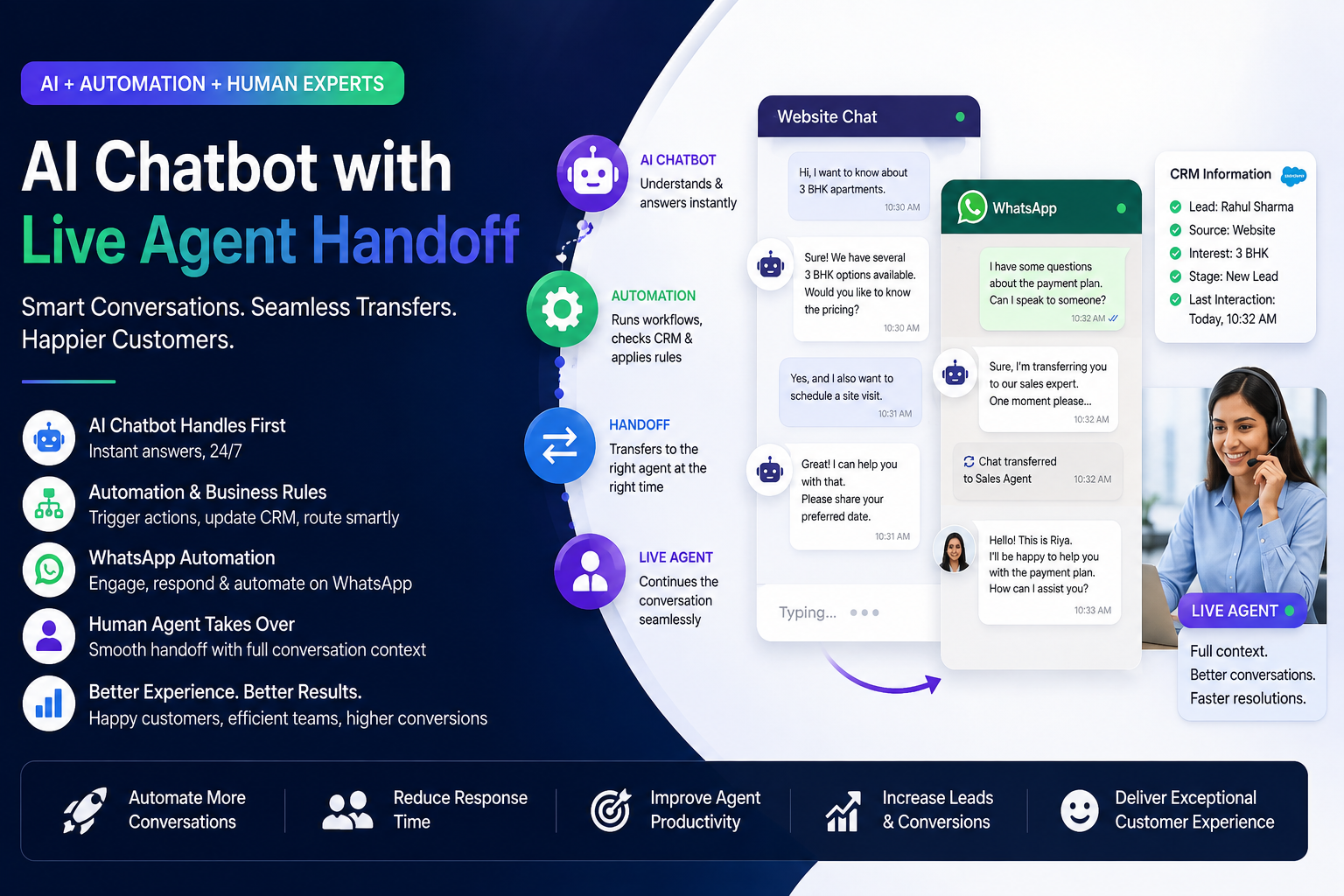
    Modern businesses can combine AI, automation, business rules, WhatsApp, CRM systems, and human agents into one conversational workflow. The AI handles routine conversations, automation executes predefined actions, and human agents take over when a conversation requires personal attention.

    This approach is becoming especially valuable for businesses managing large numbers of customer conversations across websites and WhatsApp.

    A chatbot with live agent handoff is an AI-powered conversational system that can automatically transfer a customer from a bot to a human representative when necessary.

    Instead of forcing the customer to continue talking to the AI, the system recognizes situations where human intervention is appropriate.

    A typical conversation can work like this:

    **Customer → AI Chatbot → Intent Detection → Business Rules → Automation → Human Agent When Required**

    For example, a customer might ask:

    • “What are the available apartments?”

    The AI can answer the question automatically.

    The customer may then ask:

    • I have already paid the booking amount. Can you check my payment status?”

    The chatbot can retrieve information from the CRM if the required integration is available.

    But if the customer says:

    • There is an issue with my payment. I want to speak to someone.”

    The conversation can be transferred to a human representative.

    This is the basic concept behind **AI to human handoff chatbot** systems.

    Why Do Businesses Need AI-to-Human Handoff?

    Traditional chatbots generally follow one of two approaches.

    1. The first is a simple rule-based bot that provides predefined answers.
    2. The second is an AI chatbot that understands natural language and generates responses.
    3. Both approaches have limitations when used independently.

    –>A rule-based chatbot can provide predictable workflows, but it may struggle when customers ask questions outside predefined paths.

    –>An AI chatbot can understand a much wider range of questions, but businesses may still need strict rules for sensitive workflows, escalation, routing, and operational processes.

    –>A hybrid approach combines the strengths of both.

    1) AI can handle:

    * Natural-language questions
    * Product information
    * Frequently asked questions
    * Customer intent
    * General support
    * Information requests
    * Conversation context

    2) Rules can control:

    * Lead routing
    * Customer segmentation
    * Escalation
    * Business processes
    * Agent assignment
    * CRM updates
    * Appointment workflows
    * Support workflows

    3) Human agents can handle:

    * Complex problems
    * Negotiations
    * Complaints
    * High-value customers
    * Sensitive requests
    * Exceptions
    * Sales conversations
    * Issues requiring human judgment

    This creates a more practical customer service model.

    • # How AI to Human Handoff Works

    A modern chatbot agent transfer feature does not have to mean simply displaying a button that says “Talk to an agent.”

    The transfer can be triggered automatically based on conversation context, customer intent, business rules, or a specific customer request.

    A simplified workflow looks like this:

    **Customer starts conversation**

    **AI understands the request**

    **AI provides information or performs an automated action**

    **System evaluates whether human intervention is required**

    **Conversation is routed to the appropriate agent**

    **Human agent continues the conversation**


    The important part is that the customer should not have to repeat everything they have already explained.

    The agent should receive the conversation context whenever the platform supports it.

    For example:

    > Customer: “I want to book a site visit for a 3-bedroom apartment.”

    The chatbot collects the required information.

    > Customer: “I also have a question about the payment plan.”

    If the question requires a salesperson, the system can transfer the conversation to the appropriate representative.

    The agent can then continue from the existing conversation rather than asking:

    > “How can I help you?”

    This makes the transition much more natural.


    • WhatsApp Bot Human Transfer

    WhatsApp has become an important customer communication channel for many businesses.

    Customers often start conversations through WhatsApp because they already use it every day.

    A business can therefore combine a WhatsApp bot with human transfer functionality.

    A typical **WhatsApp automation with human transfer** workflow can look like:

    **Customer sends WhatsApp message**

    **WhatsApp bot understands the request**

    **Bot provides information**

    **Customer requests human assistance**

    **System identifies the appropriate agent**

    **Conversation is transferred**

    **Human representative continues the conversation**

    For example:

    > “I want to know whether my booking has been confirmed.”

    The WhatsApp bot can potentially retrieve the relevant information through connected business systems.

    But if the customer says:

    > “There is a problem with my booking and I need someone to call me.”

    The conversation can be escalated to an appropriate team member.

    This creates a combination of **automation and human support**, instead of forcing customers into an entirely automated experience.


    •  WhatsApp Bot vs WhatsApp Bot with Human Transfer

    There is a major difference between basic WhatsApp automation and a system designed for human escalation.

    ### Basic WhatsApp bot

    Customer → Bot → Answer

    ### WhatsApp bot with human transfer

    Customer → Bot → Understand Intent → Automate → Escalate → Human Agent

    The second model is more suitable for businesses where customer conversations can become complex.

    For example, a real estate company may receive:

    * Property inquiries
    * Pricing questions
    * Site visit requests
    * Booking questions
    * Payment questions
    * Construction updates
    * Complaints
    * Existing customer requests

    Not every conversation should follow the same automation path.

    Some can be completed by AI.

    Some require CRM information.

    Some require a predefined workflow.

    Others require a salesperson or support representative.

    • WhatsApp CRM Agent Routing

    The next step is connecting the conversation with the company’s CRM.

    With **WhatsApp CRM agent routing**, customer conversations can potentially be connected to CRM information and routing workflows.

    Instead of treating WhatsApp as an isolated communication channel, the business can connect the conversation to its existing customer-management process.

    For example:

    **WhatsApp**

    **AI Bot**

    **Customer Identification**

    **CRM**

    **Conversation Context**

    **Agent Routing**

    **Sales / Support Representative**

    This can help businesses reduce manual work and improve response management.

    For example, a company may have separate teams for:

    * New sales inquiries
    * Existing customers
    * Technical support
    * Billing
    * Site visits
    * Customer service

    Instead of sending every conversation to the same representative, routing rules can determine where the conversation should go.

    • What Is a Hybrid AI Chatbot Platform?

    A **hybrid AI chatbot platform** combines multiple approaches to conversational automation.

    Rather than depending entirely on AI or entirely on predefined rules, the platform can use both.

    A typical hybrid architecture can include:

    ### 1. AI Layer

    Understands natural language and customer intent.

    ### 2. Rule Engine

    Controls business-specific conditions and workflows.

    ### 3. Automation Layer

    Performs actions such as creating records, booking appointments, updating systems, or triggering workflows.

    ### 4. Integration Layer

    Connects the chatbot with CRM, WhatsApp, calendars, websites, helpdesk systems, and other business applications.

    ### 5. Human Agent Layer

    Allows conversations to be transferred to employees when automation is no longer appropriate.

    This model provides more control than relying on AI alone.

    • Why Rule-Based Automation Still Matters

    AI is powerful, but businesses still need predictable processes.

    Consider a customer asking:

    > “Can I cancel my booking?”

    A business may have specific rules around cancellation.

    The chatbot should not simply generate an answer based on general knowledge.

    Instead, the conversation can follow a controlled workflow.

    For example:

    **Customer Request**

    **Identify Customer**

    **Check Booking**

    **Check Applicable Rules**

    **Create Support Request**

    **Notify Appropriate Team**

    **Transfer to Human Agent if Required**

    This is one reason hybrid conversational systems are useful.

    AI can understand what the customer is asking.

    Rules can determine what the business should do.

    Humans can handle exceptions.

    • When Should a Chatbot Transfer a Customer to a Human?

    A chatbot does not need to transfer every customer.

    The objective should be to automate routine conversations while making human assistance available when it adds value.

    Common handoff situations include:

    ### Customer explicitly requests an agent

    For example:

    > “I want to speak to someone.”

    The system should not force the customer to continue with the bot.

    ### Complex customer problem

    If the conversation involves a complicated issue that requires human judgment, escalation may be appropriate.

    ### Complaint or escalation

    Customers dealing with serious complaints may benefit from human assistance.

    ### High-value sales opportunity

    A customer showing strong buying intent may be routed to a salesperson.

    ### Failed automation

    If the chatbot cannot confidently handle a request, transferring the conversation can prevent a frustrating customer experience.

    ### Sensitive information

    Some requests may require human verification or intervention.

    ### Business-specific conditions

    Rules can determine when a conversation must be transferred.


    • How Bot-to-Live-Rep Routing Software Works

    The basic objective of **bot to live rep routing software** is to move conversations from automated systems to the appropriate human representative.

    Instead of manually monitoring every conversation, businesses can establish routing rules.

    For example:

    **New Property Inquiry**

    → Sales Team

    **Existing Customer**

    → Customer Support

    **Payment Issue**

    → Finance Team

    **Site Visit Request**

    → Sales Executive

    **Technical Issue**

    → Support Team

    The exact routing logic depends on the organization’s processes.

    A sophisticated system can combine customer information, conversation context, intent, business rules, and CRM information to determine the appropriate destination.

    • AI Chatbot with CRM Agent Escalation

    Connecting the chatbot to a CRM can make human escalation more useful.

    Consider a returning customer.

    The chatbot may identify the customer and access available CRM information.

    Instead of the agent starting from scratch, the system can provide context such as:

    * Customer information
    * Previous conversations
    * Lead status
    * Existing requests
    * Appointment information
    * Relevant CRM records

    The agent can then focus on solving the customer’s problem rather than collecting basic information again.

    This is the practical value of an **AI chatbot with CRM agent escalation**.

    The chatbot becomes the first layer of interaction, while the CRM provides business context and the human agent handles conversations that require personal attention.

    Example: Real Estate AI Chatbot with Human Handoff

    Consider a property developer receiving hundreds of conversations every day.

    A potential buyer visits the website and asks:

    > “Do you have 3 BHK apartments?”

    The AI chatbot answers the question.

    The buyer then asks:

    > “What is the price?”

    The chatbot provides the available information.

    The customer continues:

    > “Can I schedule a site visit tomorrow?”

    The chatbot starts the site-visit workflow.

    The customer then says:

    > “I have a few questions about the payment plan. Can I speak to a sales executive?”

    This is where human handoff becomes valuable.

    The conversation can move from:

    **AI Chatbot**

    to

    **Sales Representative**

    without forcing the customer to restart the conversation.

    The result is a blended experience:

    **AI for speed**

    *

    **Automation for efficiency**

    *

    **Human agents for complex conversations**

    •  What Happens After the Human Agent Takes Over?

    A good handoff should not simply transfer the customer.

    The system should preserve the conversation context wherever supported.

    The human agent can then understand:

    * What the customer asked
    * What information was already provided
    * What the customer is trying to accomplish
    * Which workflow was triggered
    * Why the conversation was escalated

    This reduces repetitive questions and creates a smoother customer experience.

    The ideal experience is:

    > **Customer talks to AI → AI understands → automation handles routine tasks → human takes over when needed.**

    The customer should experience this as one continuous conversation.

    • Benefits of AI and Human Agent Collaboration

    A hybrid conversational approach can provide several operational benefits.

    ## Faster initial responses

    AI can respond immediately to routine questions instead of making customers wait for an employee.

    ## Reduced repetitive work

    Employees don’t need to answer the same basic questions repeatedly.

    ## Better agent productivity

    Human representatives can spend more time on conversations that actually require their involvement.

    ## Better customer experience

    Customers can receive automated answers when appropriate while still having access to a human representative.

    ## More controlled automation

    Rules can control important business processes instead of leaving everything to AI-generated responses.

    ## Better use of CRM data

    Connected systems can provide agents and customers with relevant information during conversations.

    • The Future of Customer Conversations Is Hybrid

    Businesses don’t have to choose between a chatbot and a human support team.

    The better model is to connect them.

    A modern conversational platform can allow AI to handle routine customer interactions while business rules control important workflows and human agents step in when necessary.

    This is particularly useful for businesses operating across websites, WhatsApp, CRM systems, and multiple customer service teams.

    The objective isn’t simply to create a chatbot that talks.

    The objective is to create a system that can **understand conversations, perform actions, route customers, access business information, and involve human employees at the right moment.**

    That’s the real value of combining AI with automation and human support.

    • Conclusion

    A **chatbot with live agent handoff** provides a practical middle ground between fully automated customer service and completely manual support.

    With the right architecture, businesses can combine:

    **AI chatbot + rule-based automation + CRM + WhatsApp + agent routing + human support**

    into one customer conversation.

    Instead of asking whether AI or humans should handle customer interactions, businesses can ask a better question:

    > **Which parts of the customer journey should AI automate, and where should a human take over?**

    That is where hybrid conversational automation becomes valuable.

    For businesses looking to automate customer conversations without removing human support, a platform such as **Livserv AI** can bring AI conversations, business rules, CRM workflows, WhatsApp automation, and human-agent escalation into a connected customer communication process.

  • Best Conversational AI for Real Estate: The Complete Guide to Smarter Lead Engagement, Faster Sales, and Better Customer Experience

    Best Conversational AI for Real Estate: The Complete Guide to Smarter Lead Engagement, Faster Sales, and Better Customer Experience

    Real Estate Needs Conversational AI

    Real estate buyers don’t browse only during office hours.

    Many inquiries happen:

    • Late at night
    • Weekends
    • Public holidays
    • During travel
    • From mobile devices

    If nobody responds immediately, prospects move to another builder.

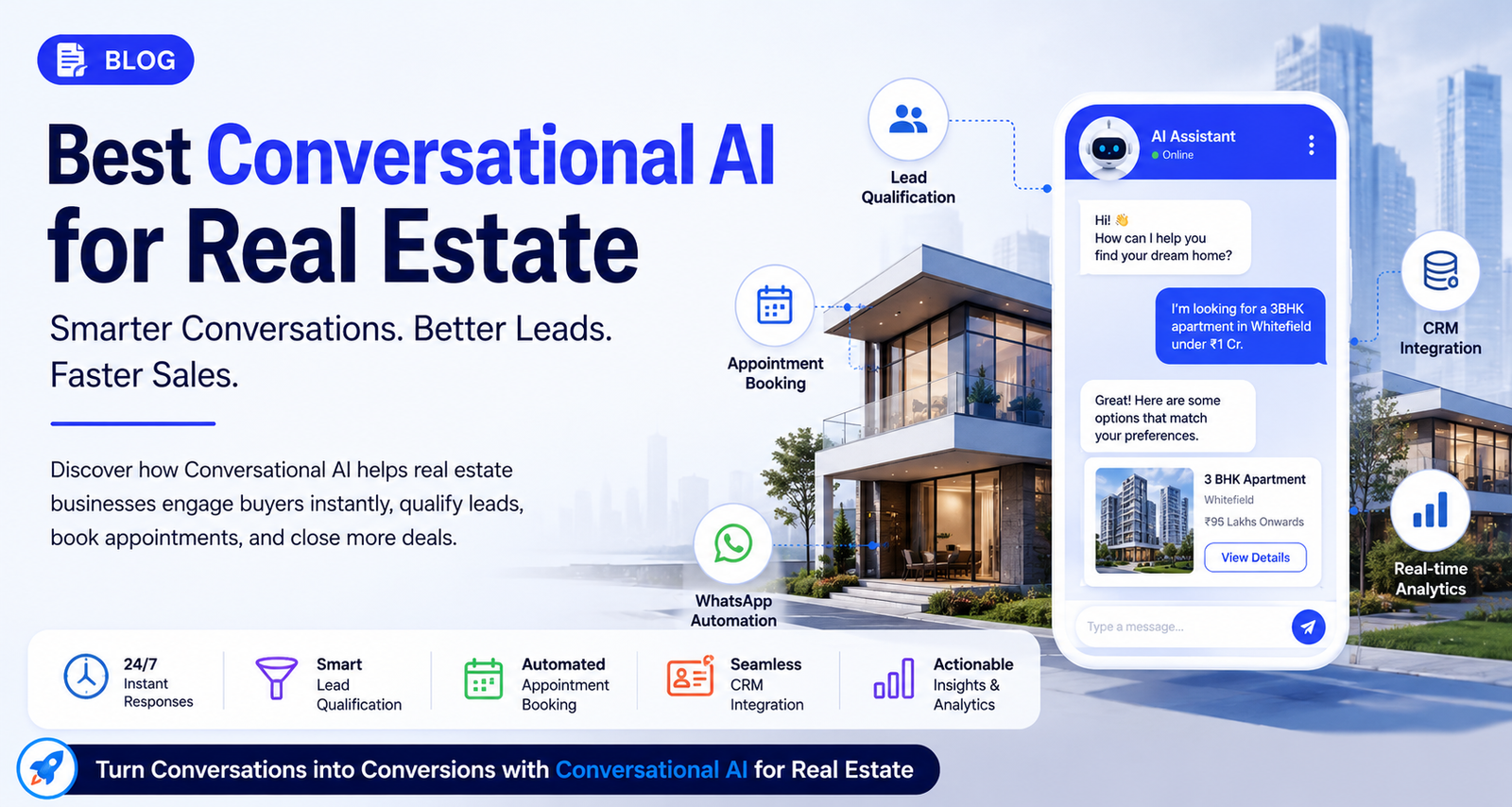
    Conversational AI works 24×7 and ensures every inquiry receives an instant response.

    It never gets tired.

    It never misses a lead.

    It never keeps customers waiting.

    Key Benefits of Conversational AI for Real Estate

    1. Instant Lead Response

    Speed matters.

    Studies consistently show that businesses responding within minutes have a much higher chance of converting leads than those responding hours later.

    Conversational AI instantly engages visitors and captures their interest before competitors do.

    Suggested internal link:

    AI Chatbot for Real Estate

    2. Intelligent Lead Qualification

    Not every inquiry is ready to buy.

    AI automatically identifies:

    1. Budget
    2. Preferred location
    3. Property type
    4. Timeline
    5. Loan requirement
    6. Investment purpose

    Sales teams receive qualified leads instead of spending hours filtering inquiries.

    Suggested internal link:

    Real Estate Lead Qualification Automation

    3. Live Property Information

    Modern conversational AI can integrate with CRM and inventory systems.

    Instead of showing outdated information, it can provide:

    • Available inventory
    • Unit status
    • Pricing
    • Floor plans
    • Offers
    • Payment plans
    • Possession dates

    Customers receive real-time information without waiting for an executive.

    4. Appointment Scheduling

    One of the biggest operational challenges is coordinating site visits.

    Conversational AI can:

    • Show available time slots
    • Book appointments
    • Assign sales
    • representatives
    • Update calendars
    • Send confirmations

    The entire booking process becomes automated.

    Suggested internal link:

    Real Estate Appointment Booking Automation
    5. CRM Integration

    The best conversational AI doesn’t work in isolation.

    It integrates with CRM platforms to:

    • Create new leads
    • Update existing records
    • Assign sales executives
    • Record conversation
    • history
    • Track customer
    • preferences

    This eliminates manual data entry.

    Suggested internal link:

    CRM Automation for Real Estate

    6. WhatsApp Conversations

    Many buyers prefer WhatsApp over websites.

    Conversational AI can seamlessly continue conversations on WhatsApp, allowing customers to:

    Ask questions

    • Receive brochures
    • Share documents
    • Confirm appointments
    • Connect with sales representatives

    This creates a smoother customer experience.

    Suggested internal link:

    WhatsApp Automation for Real Estate

    7. Customer Support

    Conversational AI isn’t only for sales.

    Existing customers often ask:

    • Construction updates
    • Payment schedules
    • Possession timelines
    • Documentation
    • requirements
    • Maintenance information

    AI answers these questions instantly, reducing the workload on customer support teams.

    Features to Look for in the Best Conversational AI for Real Estate

    Not every AI platform offers the same capabilities.

    When evaluating solutions, look for:

    Natural Conversations

    The AI should understand free-form questions rather than relying on buttons.

    CRM Connectivity

    It should fetch live customer and property information directly from your CRM.

    Inventory Access

    Customers should receive real-time availability instead of static information.

    Appointment Booking

    Allow customers to book meetings without manual coordination.

    Multi-channel Support

    The platform should work across:

    • Website
    • WhatsApp
    • Facebook Messenger
    • Mobile applications
    • Human Handover

    When required, conversations should seamlessly transfer to live agents without losing context.

    Analytics

    Track:

    • Lead sources
    • Conversion rates
    • Frequently asked questions
    • Conversation outcomes
    • Customer intent

    These insights help improve marketing and sales performance.

    Use Cases Across the Buyer Journey

    Conversational AI supports customers at every stage of the buying process.

    Discovery Stage

    Customers ask:

    Which projects are available?
    What locations do you cover?
    What is the starting price?

    AI responds instantly.

    Consideration Stage

    Customers compare:

    1. Amenities
    2. Floor plans
    3. Payment plans
    4. Offers
    5. Nearby schools
    6. Connectivity

    AI provides detailed comparisons.

    Decision Stage

    Customers schedule:

    Site visits
    Sales consultations
    Virtual tours

    The AI handles scheduling and confirmations.

    Post-Sales Support

    Existing buyers receive assistance with:

    • Documentation
    • Construction updates
    • Payment schedules
    • Customer service
    • requests
    • How Conversational AI
    • Improves Sales
    • Productivity

    Sales executives often spend a large portion of their day answering repetitive questions.

    Examples include:

    Is the project RERA approved?
    What’s the price?
    Which units are available?
    Is parking included?
    Can I book a visit?

    Conversational AI handles these repetitive interactions automatically.

    Sales teams can focus on:

    Closing deals
    Conducting site visits
    Building relationships
    Negotiating with serious buyers

    The result is higher productivity and improved conversion rates.


    Traditional Live Chat

    Conversational AI 

    • Office hours only
    • Human-dependent
    • Limited scalability
    • Manual lead qualification
    • Manual CRM updates
    • Basic FAQ responses
    • Limited automation
    • Available 24×7
    • AI-driven
    • Handles thousands of conversations simultaneously
    • Automatic qualification
    • Automated CRM integration
    • Context-aware conversations
    • Complete workflow automation
    Industries Benefiting from Real Estate Conversational AI

    The technology is valuable for:

    • Real estate developers
    • Property builders
    • Real estate agencies
    • Channel partners
    • Property consultants
    • Commercial property firms
    • Villa developers
    • Luxury housing projects
    • Residential apartment builders
    • Rental property companies
    • Common Questions
    • Buyers Ask

    The best conversational AI can answer questions such as:

    • Which apartments are available?
    • What’s the carpet area?
      What is the booking amount?
    • Can I schedule a visit?
    • Is home loan assistance available?
    • Are there any ongoing offers?
    • Can I download the brochure?
    • What’s the possession timeline?
    • Are pets allowed?
    • What’s included in maintenance charges?

    Instead of waiting for an executive, buyers receive immediate responses.

    Future of Conversational AI in Real Estate

    The future extends far beyond answering questions.

    Modern AI platforms are evolving to:

    • Understand customer preferences over multiple conversations.
    • Retrieve live property and customer information from connected systems.
    • Automate appointment booking and workflow actions.
    • Integrate seamlessly with CRM, calendars, and communication channels.
    • Support multilingual conversations for broader customer reach.
    • Provide insights into customer intent to help sales teams prioritize opportunities.

    As these capabilities mature, conversational AI is becoming an operational layer that connects customer conversations directly with business processes, reducing manual effort while improving the buying experience.

    Conclusion

    The real estate market is becoming increasingly competitive, and customer expectations continue to rise. Buyers expect immediate, accurate, and personalized responses regardless of the time of day or the channel they use.

    Choosing the best conversational AI for real estate is no longer just about adding a chat widget to your website. The real value comes from a platform that can understand natural conversations, access live business data, automate routine processes, integrate with your CRM, schedule appointments, and seamlessly transfer complex cases to human agents.

    For developers, brokers, agencies, and property consultants, conversational AI for real estate can help improve response times, streamline operations, enhance customer satisfaction, and allow sales teams to focus on high-value interactions instead of repetitive tasks.

    Businesses that successfully combine AI-powered conversations with workflow automation will be better positioned to deliver faster service, improve operational efficiency, and create a more consistent customer experience across every touchpoint.

  • Hospital WhatsApp AI Automation: Transforming Patient Communication with AI

    Hospital WhatsApp AI Automation: Transforming Patient Communication with AI

    AI That Connects with Your Hospital, Not Just Your Website

    One of the biggest limitations of traditional chatbots is that they work in isolation. They answer a few predefined questions but cannot access live hospital information or perform meaningful actions.

    Livserv.ai is different.

    Instead of functioning as a standalone chatbot, it becomes an intelligent layer that connects with your existing hospital systems. This allows the AI to retrieve live information and respond based on real-time data rather than static content.

    Depending on your hospital infrastructure, Livserv.ai can integrate with:

    • Hospital Management Systems (HMS)
    • Customer Relationship Management (CRM) platforms
    • Doctor availability systems
    • Appointment booking applications
    • Internal knowledge bases
    • REST APIs and third-party healthcare software

    This means patients receive accurate information without requiring hospital staff to manually verify every request.

    From Questions to Actions

    The real purpose of AI in hospitals is not simply answering questions.

    It is helping patients complete tasks.

    For example, consider the following conversation.

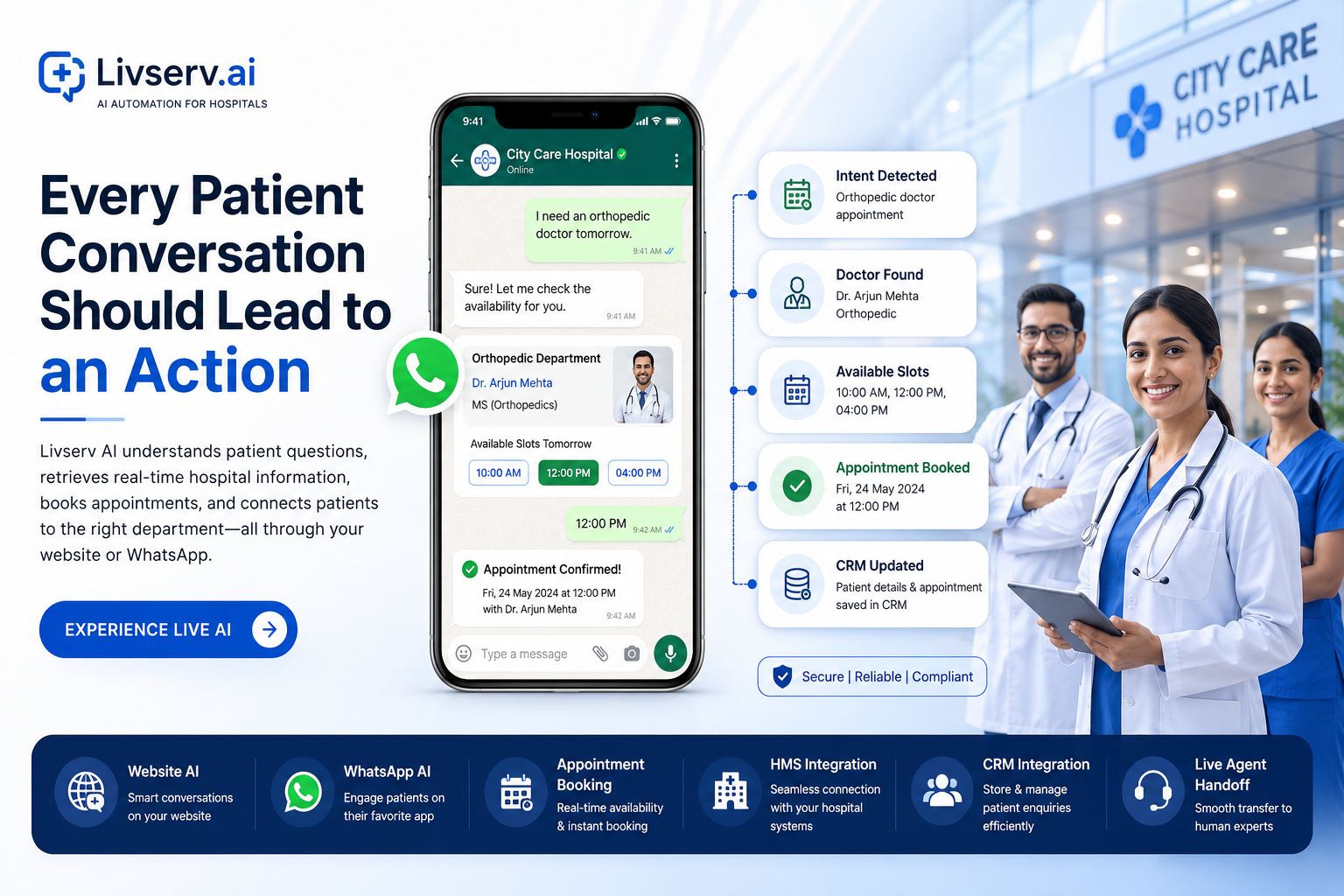
    Patient: I need to consult a neurologist this Friday.

    Instead of replying with a phone number, Livserv.ai can:

    • Identify the Neurology department.
    • Retrieve available doctors.
    • Display available consultation slots.
    • Allow the patient to select a preferred time.
    • Confirm the booking.
    • Store the enquiry in the hospital CRM.

    The patient completes the entire process within one conversation.

    No waiting.

    No repeated phone calls.

    No manual coordination.

    Intelligent Hospital Knowledge Base

    Every hospital has a large amount of information spread across its website.

    Patients often search for information like:

    • Departments
    • Doctors
    • Specialties
    • Medical procedures
    • Health check packages
    • ICU availability
    • Emergency care
    • Diagnostic services
    • Insurance partners
    • Visitor policies

    Finding this information manually can be frustrating.

    Livserv.ai indexes the hospital’s knowledge base so patients can simply ask questions naturally.

    Examples include:

    “Do you have pediatric cardiology?”

    “Which doctor treats migraine?”

    “Where is your oncology department?”

    “Do you provide knee replacement surgery?”

    Instead of searching through multiple pages, patients receive the answer immediately.

    Reducing Reception Workload

    Reception teams are one of the busiest departments in any hospital.

    A large percentage of their daily conversations involve repetitive enquiries.

    Examples include:

    • Consultation timings
    • Department locations
    • Available specialists
    • Registration procedures
    • Parking facilities
    • Billing enquiries
    • Appointment booking

    Although these questions are simple, answering hundreds of them every day consumes valuable staff time.

    With Livserv.ai, AI handles these routine conversations instantly, allowing reception staff to focus on patients who genuinely require personal assistance.

    This improves operational efficiency without compromising patient service.

    AI Works Alongside Hospital Staff

    One concern many hospitals have is whether AI will replace human employees.

    The answer is no.

    Healthcare requires empathy, medical expertise, and clinical judgment—areas where healthcare professionals remain essential.

    Livserv.ai is designed to support hospital teams by automating repetitive communication tasks.

    Whenever a conversation requires human intervention, such as complex billing issues or medical discussions that should be handled by qualified professionals, the AI can seamlessly transfer the conversation to a hospital representative.

    The staff member receives the conversation history, eliminating the need for patients to repeat themselves.

    This creates a smoother and more efficient support experience.

    Website and WhatsApp: A Unified Experience

    Patients interact with hospitals through different channels.

    Some prefer visiting the website.

    Others prefer WhatsApp.

    Livserv.ai delivers a consistent conversational experience across both channels.

    Regardless of where the patient starts the conversation, they receive accurate information based on the same hospital knowledge base and integrated systems.

    This ensures consistency while reducing the need to maintain multiple support processes.

    A Typical Patient Journey with Livserv.ai

    Patient Visits Website or WhatsApp

                │

                ▼

    Starts Conversation

                │

                ▼

    AI Understands Patient Intent

                │

                ▼

    Retrieves Information from HMS / CRM / Knowledge Base

                │

                ▼

    Answers Question or Performs Requested Action

                │

                ▼

    Appointment Booked or Live Agent Connected

                │

                ▼

    Conversation Completed

    The focus is on helping the patient complete their objective as quickly as possible.

    Common Use Cases

    Hospitals can use Livserv.ai across many departments and patient touchpoints.

    Appointment Booking

    Patients can search for doctors, choose specialties, and request appointments through a conversational interface.

    Doctor Information

    Patients can learn about a doctor’s specialty, qualifications, consultation timings, and availability.

    Department Guidance

    Patients can locate departments such as Cardiology, Neurology, Orthopedics, Pediatrics, Oncology, Dermatology, or Emergency Care.

    Insurance Information

    Patients can ask whether specific insurance providers are accepted and receive guidance based on the hospital’s published information.

    Health Packages

    Patients can explore available health check packages and diagnostic services before making a decision.

    Hospital Services

    Patients can quickly understand what services the hospital offers without navigating multiple webpages.

    Live Agent Transfer

    When a patient requires additional assistance, the AI transfers the conversation to a hospital executive while preserving the conversation history.

    Why Hospitals Are Choosing Conversational AI

    Hospital administrators are under constant pressure to improve efficiency while maintaining excellent patient care.

    Conversational AI helps achieve both goals.

    Benefits include:

    • Faster response times
    • Reduced workload for reception teams
    • Better patient engagement
    • Improved website usability
    • Higher appointment conversion rates
    • Consistent information across all channels
    • Real-time access to hospital information
    • Scalable patient support without increasing administrative overhead

    As patient expectations continue to evolve, conversational AI is becoming a key component of modern healthcare delivery.

    Choosing the Right AI Platform

    Not all chatbot platforms are built for healthcare.

    When evaluating an AI solution, hospitals should consider whether it can:

    • Understand natural language rather than relying on fixed keywords.
    • Integrate with existing hospital systems.
    • Retrieve live information instead of static responses.
    • Support appointment booking workflows.
    • Provide seamless human handoff.
    • Work across both website and WhatsApp.
    • Be trained using hospital-specific knowledge.
    • Scale as patient enquiries grow.

    Selecting an AI platform with these capabilities ensures that it becomes a valuable operational tool rather than just another communication channel.

    Why Livserv.ai Stands Out

    Livserv.ai is built around a simple philosophy: help patients complete tasks, not just ask questions.

    Instead of functioning as a standalone FAQ bot, it acts as an intelligent conversational automation platform that works with your hospital’s existing systems.

    Hospitals can use Livserv.ai to:

    • Deliver instant patient assistance.
    • Improve website engagement.
    • Simplify appointment booking.
    • Connect conversations with CRM and HMS platforms.
    • Provide accurate information using a centralized knowledge base.
    • Enable smooth handoffs to hospital staff whenever human expertise is required.

    This approach helps hospitals modernize patient communication while preserving the personal care that defines quality healthcare.

    Final Thoughts

    The future of hospital communication is not about replacing people with technology. It is about using technology to remove unnecessary friction from everyday interactions.

    Patients want answers without waiting. They want to book appointments without making multiple phone calls. They want information that is accurate, easy to access, and available when they need it.

    Hospital WhatsApp AI Automation makes this possible.

    By combining conversational AI, intelligent knowledge retrieval, live system integration, and seamless appointment workflows, hospitals can provide a faster, more convenient experience while allowing healthcare professionals to focus on what they do best—caring for patients.

    With Livserv.ai, every patient conversation becomes an opportunity to deliver better service, improve operational efficiency, and build stronger trust through intelligent, responsive communication.

    Frequently Asked Questions (FAQ)

    1. What is Hospital WhatsApp AI Automation?

    It is the use of Artificial Intelligence within WhatsApp to help hospitals respond to patient enquiries, provide hospital information, and automate actions such as appointment booking during patient-initiated conversations.

    1. Does Livserv.ai replace hospital staff?

    No. Livserv.ai automates routine conversations and transfers complex or sensitive enquiries to hospital staff when human assistance is needed.

    1. Can Livserv.ai integrate with Hospital Management Systems?

    Yes. Livserv.ai is designed to integrate with Hospital Management Systems, CRM platforms, and other business applications through APIs where available.

    1. Does the AI understand natural language?

    Yes. Patients can ask questions in their own words, and the AI interprets their intent rather than relying only on predefined keywords.

    1. Can patients book appointments through WhatsApp?

    Yes. If integrated with the hospital’s appointment system, patients can request appointments, check availability, and complete bookings directly within the conversation.

    1. Does Livserv.ai send promotional or follow-up messages automatically?

    No. Livserv.ai primarily operates as a reactive conversational AI, responding when patients initiate a conversation rather than sending unsolicited outreach.

    1. Can the AI answer questions about doctors and departments?

    Yes. It can provide information from the hospital’s knowledge base about doctors, specialties, departments, services, and other hospital information.


  • Hospital WhatsApp AI Automation: How AI is Transforming Patient Communication Without Replacing Your Hospital Staff

    Hospital WhatsApp AI Automation: How AI is Transforming Patient Communication Without Replacing Your Hospital Staff

    Introduction

    Healthcare has changed dramatically over the past decade it has become more AI based environment. Patients no longer rely only on phone calls or physical visits to interact with hospitals. Before making an appointment, they expect to find answers instantly, compare doctors, check hospital services, understand insurance coverage, and book consultations without waiting for a receptionist.

    Unfortunately, many hospitals still depend on manual communication. Reception desks spend a significant portion of their day answering the same questions repeatedly:

    • Which doctor should I consult?
    • Is Dr. Kumar available today?
    • What are the consultation charges?
    • Where is the cardiology department?
    • How can I book an appointment?
    • Does the hospital accept cashless insurance?
    • What are the OPD timings?

    These conversations are important, but they consume valuable staff time that could be better spent helping patients who require personal attention.

    This is where Hospital WhatsApp AI Automation creates real value.

    Unlike traditional chatbots that simply display predefined answers, Livserv.ai uses Artificial Intelligence to understand patient questions, retrieve information from your hospital’s knowledge base or connected systems, and complete actions such as appointment booking or transferring the conversation to a live executive when necessary.

    The result is faster patient service, lower administrative workload, and a better overall patient experience.

    Why Hospitals Need AI on WhatsApp

    WhatsApp has become the preferred communication platform for millions of people. Patients already use it daily, making it the most convenient channel for interacting with hospitals.

    Instead of asking patients to download another application or navigate a complex website, hospitals can provide assistance directly through WhatsApp.

    Patients simply send a message like:

    “I need a dermatologist tomorrow.”

    or

    “Is your MRI department open today?”

    The AI understands the request and provides the appropriate response instantly.

    This removes unnecessary waiting and improves accessibility.

    The Problem with Traditional Hospital Communication

    Most hospitals still follow a manual communication process.

    Patient Needs Information

            │

            ▼

    Visits Website

            │

            ▼

    Cannot Find Information

            │

            ▼

    Calls Reception

            │

            ▼

    Reception Busy

            │

            ▼

    Patient Waits

            │

            ▼

    Receives Information

    Now imagine hundreds of patients following the same process every day.

    Reception teams become overloaded, phone lines remain busy, and patients experience delays before receiving even basic information.

    The AI-Powered Patient Journey

    With Livserv.ai, the process becomes much simpler.

    Patient Starts Chat

            │

            ▼

    Livserv AI Understands Question

            │

            ▼

    Retrieves Hospital Information

            │

            ▼

    Answers Patient

            │

            ▼

    Books Appointment (if requested)

            │

            ▼

    Updates Hospital CRM

    Everything happens within the same conversation without unnecessary delays.

    More Than a Chatbot

    One of the biggest misconceptions about AI chatbots is that they only answer frequently asked questions.

    Modern hospital AI should do much more.

    Instead of replying with static answers, Livserv.ai performs actions.

    For example, when a patient asks:

    “Book an appointment with an orthopedic doctor tomorrow afternoon.”

    The AI doesn’t simply provide a phone number.

    It can:

    • Identify the Orthopedics department.
    • Check available doctors.
    • Retrieve available appointment slots.
    • Allow the patient to choose a convenient time.
    • Confirm the appointment.
    • Update the connected CRM or Hospital Management System.

    This transforms a simple conversation into a completed business process.

    AI That Understands Natural Conversations

    Patients rarely ask questions in the same way.

    For example:

    • I need a heart specialist.
    • I have chest pain.
    • Can I see a cardiologist?
    • Heart doctor available today?
    • Best cardiologist near me.

    Although the wording is different, the intent is the same.

    Using Natural Language Processing and Large Language Models, Livserv.ai understands the patient’s intent instead of searching only for exact keywords.

    This makes conversations feel more natural and significantly improves the patient experience.

    Instant Access to Hospital Information

    Patients often need information before deciding whether to visit a hospital.

    Common enquiries include:

    • Departments available
    • Doctor profiles
    • Consultation timings
    • Hospital facilities
    • Insurance partners
    • Diagnostic services
    • Health packages
    • Emergency services
    • Visiting hours
    • Contact information

    Instead of forcing patients to browse multiple web pages, Livserv.ai provides the required information immediately within the chat.

    This improves both convenience and engagement.

    AI Appointment Booking

    Appointment booking is one of the most valuable uses of AI in hospitals.

    Traditional booking often involves:

    • Calling reception
    • Waiting for staff
    • Checking doctor availability manually
    • Confirming appointments over the phone

    This process becomes slow during peak hours.

    Livserv.ai automates this interaction while keeping the patient in control.

    The patient simply specifies the specialty or doctor they want, and the AI guides them through the booking process.

    If integrated with the hospital’s scheduling system, available slots can be presented in real time, making the process quick and accurate.

    Real-Time Integration with Hospital Systems

    The true strength of Livserv.ai lies in its ability to integrate with existing hospital technology.

    Rather than maintaining isolated information, the AI can connect securely with:

    This enables the AI to provide real-time information rather than static responses.

    For example, if a patient asks:

    “Is Dr. Mehta available this evening?”

    The AI can check the latest schedule and provide an accurate answer instead of relying on outdated information.

    A Smarter Hospital Website

    Hospital websites often contain hundreds of pages covering departments, doctors, procedures, health packages, and patient services.

    Finding the right information can be time-consuming.

    Livserv.ai acts as an intelligent search assistant.

    Instead of navigating menus, patients simply ask questions in their own words.

    The AI quickly retrieves relevant information, reducing frustration and improving website engagement.

    This also helps hospitals reduce website abandonment and increase appointment enquiries.

    Human Support When Needed

    Artificial Intelligence should enhance human service—not replace it.

    Some situations require personal attention, such as billing disputes, complex medical questions, or exceptional patient requests.

    When necessary, Livserv.ai can seamlessly transfer the conversation to a hospital executive while preserving the conversation context.

    Patients don’t have to repeat their questions, allowing staff to continue the interaction efficiently.

    Benefits for Hospitals

    Implementing Hospital WhatsApp AI Automation delivers measurable operational benefits.

    Hospitals can:

    • Reduce repetitive enquiries handled by reception staff.
    • Provide instant responses 24/7.
    • Simplify appointment booking.
    • Improve website engagement.
    • Deliver consistent information.
    • Integrate conversations with existing CRM and HMS platforms.
    • Increase operational efficiency.
    • Improve patient satisfaction.

    Most importantly, staff spend less time answering routine questions and more time assisting patients who genuinely require human expertise.

    Why Livserv.ai

    Livserv.ai is not designed to replace hospital staff.

    It is designed to automate repetitive patient conversations and complete real business actions during those conversations.

    Unlike basic FAQ chatbots, Livserv.ai combines conversational AI with hospital automation.

    It understands patient intent, retrieves information from connected systems, performs actions such as appointment booking, and seamlessly hands over conversations to live executives whenever required.

    Whether deployed on your hospital website or integrated with WhatsApp, Livserv.ai helps hospitals provide faster, more intelligent, and more efficient patient interactions while working alongside existing teams and hospital systems.

    Conclusion

    Patient expectations continue to evolve, and hospitals must adapt by making communication faster, simpler, and more accessible.

    Hospital WhatsApp AI Automation is no longer just a convenience—it is becoming an essential part of delivering modern healthcare services.

    By enabling patients to ask questions naturally, receive instant answers, and complete tasks such as appointment booking through a familiar platform, hospitals can reduce administrative workload while significantly improving the patient experience.

    With Livserv.ai, hospitals gain more than an AI chatbot. They gain an intelligent conversational automation platform that connects people, information, and hospital systems to make every patient interaction faster, smarter, and more effective.


    Frequently Asked Questions (FAQ)

    1. What is an AI Chatbot for Hospitals?

    An AI Chatbot for Hospitals is an intelligent conversational assistant that helps patients get instant answers to their questions, find doctors, learn about hospital services, and book appointments. Unlike traditional chatbots, AI-powered solutions like Livserv.ai understand natural language and can integrate with hospital systems to provide accurate, real-time information.

    1. How does a Hospital AI Chatbot improve patient experience?

    A Hospital AI Chatbot provides immediate responses to patient enquiries without requiring them to wait on hold or navigate multiple web pages. Patients can ask questions, find departments, check doctor availability, and request appointments through a simple conversation.

    1. Can patients book appointments using an AI Chatbot?

    Yes. If integrated with the hospital’s appointment scheduling system, the AI chatbot can help patients choose a department, select a doctor, view available time slots, and complete the appointment booking process during the conversation.

    1. Does the AI Chatbot replace hospital reception staff?

    No. The AI chatbot is designed to handle repetitive patient enquiries and routine tasks. When a patient requires human assistance, the conversation can be transferred to a hospital representative, allowing staff to focus on more complex interactions.

    1. What type of questions can the AI Chatbot answer?

    The chatbot can answer questions related to:

    • Hospital departments
    • Doctor information
    • Specialties
    • Consultation timings
    • Hospital facilities
    • Insurance information (based on available data)
    • Diagnostic services
    • Health packages
    • Appointment booking process
    • Contact information
    1. Does Livserv.ai support WhatsApp for hospitals?

    Yes. Livserv.ai can be deployed on WhatsApp, allowing patients to communicate with hospitals through a familiar messaging platform. Patients can ask questions, explore services, and request appointments directly from WhatsApp.

    1. Can Livserv.ai integrate with Hospital Management Systems (HMS)?

    Yes. Livserv.ai is designed to integrate with Hospital Management Systems (HMS), CRM platforms, appointment booking software, and other business applications through secure APIs where available. This allows the AI to retrieve live information and automate patient interactions.

    1. How is Livserv.ai different from a traditional chatbot?

    Traditional chatbots typically rely on predefined rules and scripted responses. Livserv.ai uses Artificial Intelligence to understand natural language, retrieve information from hospital knowledge bases or connected systems, and perform actions such as appointment booking or live agent transfer.

    1. Can the AI Chatbot help patients find the right doctor?

    Yes. Patients can describe their symptoms or specify a medical specialty, and the AI can guide them to the appropriate department or doctor based on the hospital’s available information.

    1. Is the AI available outside hospital working hours?

    Yes. Livserv.ai provides 24/7 conversational support, allowing patients to access hospital information and request services at any time, even when reception is closed.

    1. Can the AI Chatbot answer questions in multiple languages?

    Yes. Livserv.ai supports multilingual conversations, enabling hospitals to communicate with patients in their preferred language and improve accessibility for a diverse patient population.

    1. What happens if the AI cannot answer a patient’s question?

    If the AI cannot confidently answer a question or the patient requires personalized assistance, the conversation can be seamlessly transferred to a live hospital executive without losing the conversation context.

    1. Can Livserv.ai work on both websites and WhatsApp?

    Yes. Livserv.ai provides a consistent conversational experience across hospital websites and WhatsApp, allowing patients to choose the communication channel they are most comfortable with.

    1. Is Livserv.ai suitable for multi-speciality hospitals?

    Yes. Livserv.ai can support multi-speciality hospitals by providing information about different departments, doctors, specialties, and services while integrating with existing hospital systems to deliver accurate responses.

    1. Why should hospitals implement an AI Chatbot?

    Hospitals implement AI chatbots to improve patient communication, reduce repetitive administrative work, simplify appointment booking, provide faster access to hospital information, and enhance the overall patient experience without increasing the workload on hospital staff.

    Bonus SEO FAQ (Recommended)

    Can an AI Chatbot integrate with a hospital’s CRM?

    Yes. Livserv.ai can integrate with hospital CRM systems to retrieve relevant patient or enquiry information (subject to the hospital’s implementation and permissions), helping staff provide faster and more informed assistance.

    Is patient information secure with Livserv.ai?

    Livserv.ai can be integrated with secure hospital systems using authenticated APIs and follows the security architecture implemented by the hospital. Data access and handling should always comply with the organization’s security policies and applicable healthcare regulations.

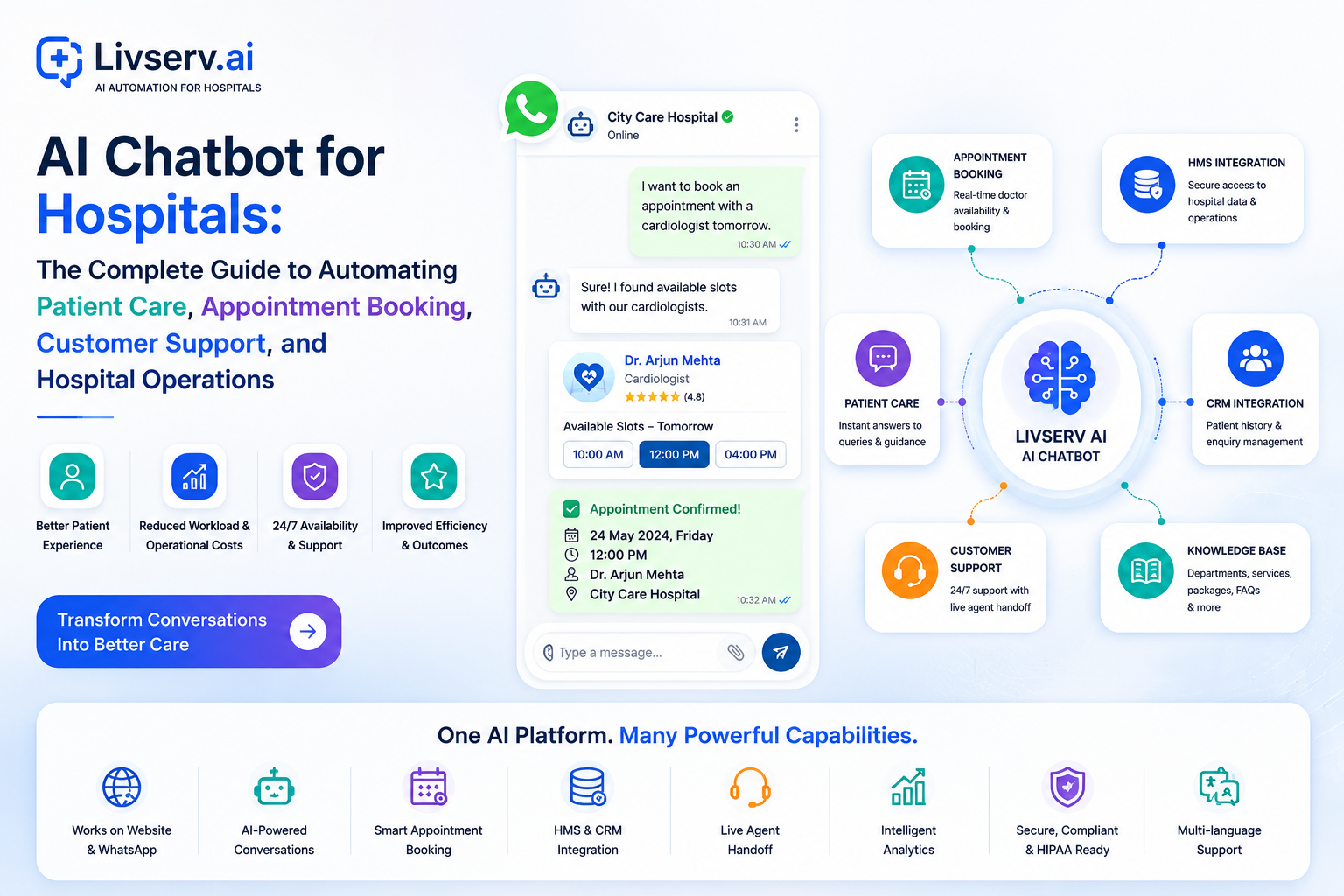
  • AI Chatbot for Hospitals: The Complete Guide to Automating Patient Care, Appointment Booking, Customer Support, and Hospital Operations in 2026

    AI Chatbot for Hospitals: The Complete Guide to Automating Patient Care, Appointment Booking, Customer Support, and Hospital Operations in 2026

    Healthcare is evolving rapidly. Patients today expect the same level of convenience from hospitals that they receive from banks, airlines, and e-commerce companies. They want instant responses, online appointment booking, WhatsApp support, real-time updates, and personalized communication—all without waiting on hold or standing in long queues.

    Unfortunately, many hospitals still rely heavily on manual processes. Reception desks are overwhelmed with phone calls, appointment scheduling is handled manually, patients repeatedly ask the same questions, and staff spend valuable time answering routine inquiries instead of focusing on patient care.

    This is where an AI Chatbot for Hospitals becomes a game changer.

    Modern AI-powered hospital assistants do much more than answer questions.

    Automate

    Appointment booking, Provide instant information, connect with hospital databases, integrate with CRM and Hospital Management Systems (HMS), assist patients 24/7, and significantly improve operational efficiency.

    Platforms like Livserv.ai help hospitals automate patient engagement across websites, WhatsApp, Facebook Messenger, and other digital channels. Instead of acting as a basic chatbot with predefined answers, Livserv AI understands patient intent, retrieves real-time information from integrated systems, and performs actions such as booking appointments, updating CRM records, escalating complex cases to live agents, and delivering personalized responses.

    The result is a smoother patient experience, reduced workload for hospital staff, lower operational costs, and higher patient satisfaction.

    Why Hospitals Need an AI Chatbot

    Hospitals receive thousands of inquiries every month. Many of these questions are repetitive and consume valuable staff time.

    Common patient questions include:

    • Which doctor should I consult?
    • Is Dr. Sharma available tomorrow?
    • Can I book an appointment online?
    • What are the consultation charges?
    • Does the hospital accept my insurance?
    • Where is the cardiology department?
    • How do I download my medical reports?
    • Can I reschedule my appointment?
    • What are your visiting hours?

    Every time a receptionist answers these routine questions, it takes attention away from patients who require immediate assistance.

    An AI Chatbot for Hospitals can answer these questions instantly, accurately, and consistently—24 hours a day, 7 days a week.

    Instead of waiting for office hours, patients receive immediate assistance whenever they need it.

    The Changing Expectations of Modern Patients

    Today’s patients expect hospitals to offer digital experiences similar to other industries.

    They want to:

    • Book appointments online
    • Receive appointment reminders
    • Chat through WhatsApp
    • Get immediate answers
    • Access reports digitally
    • Find doctors quickly
    • Receive personalized
    • healthcare information
    • Avoid unnecessary phone calls

    Hospitals that fail to meet these expectations risk losing patients to competitors offering better digital experiences.

    • An AI chatbot helps hospitals meet these expectations while improving operational efficiency.

    Patient –>Visits Website –>Cannot Find Information–>Calls Reception–>Reception Busy–>Patient Waits–>Appointment Scheduled–>Manual Follow-up

    Challenges

    • Long waiting time
    • Missed phone calls
    • Manual appointment scheduling
    • Staff overload
    • Inconsistent information
    • Poor patient experience

    How an AI Chatbot Changes Everything

    Instead of forcing patients to navigate complex websites or wait for a receptionist, AI becomes the hospital’s digital front desk.

    The Biggest Challenges Hospitals Face Today

    1. Overloaded Reception Desks

    Receptionists often answer hundreds of repetitive questions every day.

    Examples include:

    • OPD timings
    • Doctor availability
    • Department locations
    • Consultation fees
    • Parking information
    • Visiting hours

    AI automates these conversations instantly.

    2. Appointment Scheduling Bottlenecks

    Manual appointment booking leads to:

    1. Double bookings
    2. Missed appointments
    3. Long waiting times
    4. Scheduling errors
    5. Increased administrative workload

    AI automatically checks doctor availability, books appointments, sends confirmations, and issues reminders.

    3. High Call Volumes

    Many patients still call hospitals because they cannot find information online.

    Common inquiries include:

    1. Lab report status
    2. Department contacts
    3. Emergency services
    4. Pharmacy timings

    Instead of overwhelming reception staff, these questions can be answered instantly through AI.

    4. Limited Support Outside Working Hours

    Healthcare needs don’t stop at 6 PM.

    Patients often search for information during evenings, weekends, and holidays.

    An AI chatbot provides uninterrupted support around the clock.

    What Is an AI Chatbot for Hospitals?

    An AI Chatbot for Hospitals is an intelligent virtual assistant powered by advanced Artificial Intelligence and Large Language Models (LLMs). Unlike traditional rule-based chatbots that respond only to predefined questions, modern AI chatbots understand natural language, maintain conversational context, and retrieve accurate information from hospital systems.

    A hospital AI chatbot can:

    • Understand patient intent
    • Search hospital knowledge bases
    • Access doctor schedules
    • Integrate with Hospital
    • Management Systems (HMS)
    • Connect with Electronic
    • Health Records (EHR)
    • Retrieve information through secure APIs
    • Book appointments
    • Update CRM records
    • Escalate complex cases to live staff

    This transforms the chatbot from a simple FAQ tool into an intelligent digital assistant capable of performing real operational tasks.

    How Livserv AI Helps Hospitals

    Unlike many chatbot platforms that only answer static FAQs, Livserv.ai is designed to automate complete hospital workflows.

    Key capabilities include:

    Hospitals can deploy a single AI assistant that works across multiple channels while maintaining consistent patient experiences.

    For organizations looking to modernize patient engagement, Livserv AI provides dedicated healthcare solutions through its hospital platform, appointment booking automation, and hospital workflow automation offerings.