Day: April 8, 2026

  • Automotive Chatbot: Fix Variant & Pricing Confusion to Increase Car Sales

    Automotive Chatbot: Fix Variant & Pricing Confusion to Increase Car Sales

    The Buyer You Almost Converted

    A buyer lands on your website looking for a new car.

    They already have intent. They’ve done their research. They’ve shortlisted a model.

    Now they open the variant page.

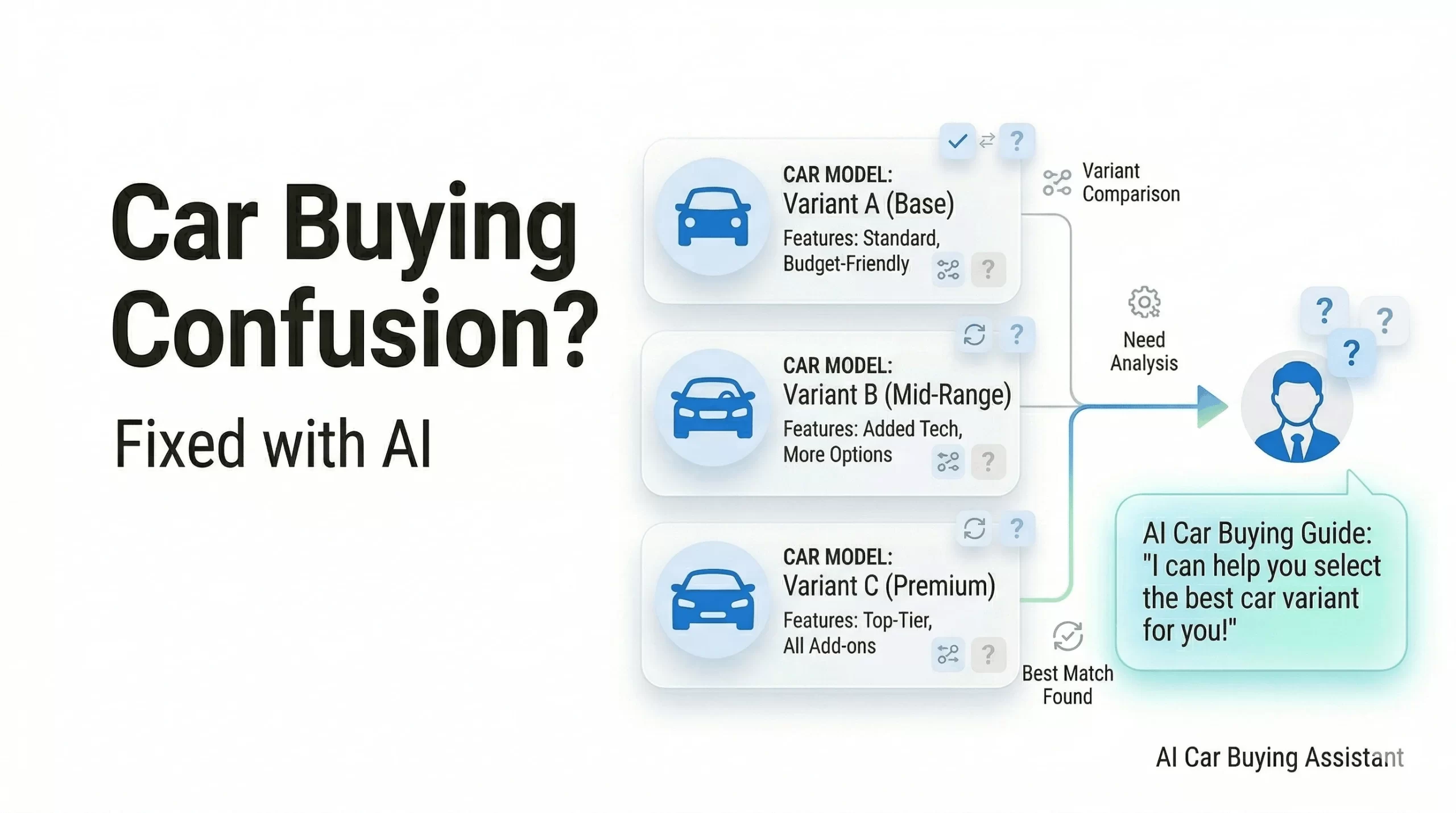
    They see multiple options — base, mid, top — each with different features, pricing, and offers.

    They start comparing.

    Within minutes, confusion sets in.

    They hesitate.

    They leave.

    This is where most automotive businesses lose high-intent buyers — not at awareness, but at decision.


    The Hidden Drop-Off in the Automotive Sales Funnel

    The modern car buying journey looks structured, but conversion is fragile:

    Awareness → Model Selection → Variant Comparison → Pricing → Test Drive → Purchase

    The biggest drop-off happens at the variant and pricing stage.

    This is the moment when:

    • The buyer is closest to booking a test drive
    • Intent is high, but clarity is low
    • Decision complexity peaks

    If businesses fail to guide the buyer here, conversion drops sharply.


    Why Buyers Drop During Variant & Pricing Decisions

    1. Too Many Variants, Too Little Clarity

    Car brands offer multiple variants to cater to different segments.

    But for buyers, this creates confusion.

    • What’s the difference between base, mid, and top?
    • Which features actually matter?
    • Is the higher variant worth the price?

    Too many choices without guidance lead to decision paralysis.


    2. Lack of Transparent Pricing

    Buyers don’t just want ex-showroom prices.

    They want the real cost.

    • On-road price
    • Insurance
    • Registration
    • Add-ons

    When pricing is unclear:

    • Trust drops
    • Hesitation increases

    Confusion around pricing delays decisions.


    3. No Instant EMI Understanding

    For most buyers, affordability matters more than total price.

    The key question is:

    “How much will I pay monthly?”

    If EMI is not instantly visible:

    • Buyers postpone decisions
    • They explore other options

    Lack of EMI clarity creates buying friction.


    4. No Guided Recommendation

    Most dealership websites act like catalogs.

    They show options but don’t guide decisions.

    There is no system to:

    • Understand buyer needs
    • Recommend the best variant

    Without guidance, buyers feel lost.


    5. Slow or No Response from Dealership

    Some buyers try to connect.

    But:

    • Responses are delayed
    • Calls go unanswered
    • Follow-ups are inconsistent

    Speed directly impacts conversions in automotive sales.


    Impact of Variant & Pricing Drop-Off on Dealerships

    This drop-off is not just a UX problem — it is a revenue problem.

    Dealerships lose:

    • High-intent buyers who were ready to act
    • Test drive bookings, the most critical conversion step
    • Sales opportunities already paid for through marketing

    You are not losing traffic — you are losing decision-stage buyers.


    How AI Chatbots Solve This Problem

    An automotive chatbot acts as a digital sales advisor.

    It helps buyers make decisions faster and with confidence.


    1. Smart Variant Recommendation Engine

    The chatbot asks simple questions:

    • What is your budget?
    • What features matter most?
    • City or highway usage?

    Based on answers, it:

    • Suggests the best-fit variant

    This removes confusion and speeds up decisions.


    2. Instant Feature Comparison

    Instead of manual comparison, the chatbot:

    • Highlights key differences
    • Simplifies complex information

    Clarity improves confidence.


    3. Real-Time Pricing Clarity

    The chatbot provides:

    • On-road price breakdown
    • Additional charges

    Transparency builds trust.


    4. EMI Calculation & Guidance

    Buyers can instantly see:

    • Monthly EMI
    • Loan options

    This answers the most critical buying question.


    5. Instant Test Drive Booking

    Instead of forms and delays:

    • Select date
    • Choose location
    • Confirm instantly

    No friction. Faster action.


    6. 24/7 Engagement

    The chatbot works all the time.

    No matter when the buyer visits:

    • They get instant answers

    No missed opportunities.


    Real-World Scenario: Before vs After AI

    StageWithout AIWith AI
    Variant SelectionConfusingGuided
    PricingUnclearTransparent
    EMINot availableInstant
    BookingManualAutomated
    ConversionLowHigh

    How Livserv.ai Helps Automotive Businesses

    Livserv.ai is an AI chatbot platform that helps automotive businesses convert leads faster through intelligent engagement.

    It enables:

    • Lead qualification based on buyer intent
    • Automated conversations
    • Variant recommendations
    • Integration with website and WhatsApp

    It bridges the gap between interest and action.


    Benefits for Dealerships

    • Faster conversions: Buyers move quickly through the funnel
    • Better experience: Guided and simplified journey
    • Reduced sales effort: Automation handles repetitive queries
    • Higher ROI: Better utilization of existing traffic

    FAQs

    Why do buyers get confused between car variants?

    Multiple options with unclear differences create decision overload.

    What is an automotive chatbot?

    An automotive chatbot is an AI-powered tool that helps buyers compare cars, understand pricing, and book test drives.

    How can dealerships increase conversions?

    By providing instant guidance, transparent pricing, and reducing friction using AI chatbots.

    Do chatbots help in car sales?

    Yes, they improve engagement, reduce confusion, and accelerate buying decisions.

    Can chatbots calculate EMI?

    Yes, modern AI chatbots provide instant EMI calculations and loan insights.

    Do chatbots work on WhatsApp?

    Yes, they can engage customers directly on WhatsApp for better conversions.


    Conclusion: The Decision Stage That Drives Sales

    Buyers don’t drop because they are not interested.

    They drop because they are confused.

    The variant and pricing stage is where:

    • decisions slow down
    • uncertainty increases
    • buyers leave

    AI chatbots remove confusion and guide buyers toward action.

    When you simplify decisions, you don’t just improve experience.

    You increase test drives, conversions, and revenue.

    The opportunity is already there.

    The question is whether you are capturing it.
  • Patients Dropping Off During Doctor Selection? Fixing the Specialty & Availability Gap with AI

    Patients Dropping Off During Doctor Selection? Fixing the Specialty & Availability Gap with AI

    A Patient You’re Losing Right Now

    A patient visits your hospital website late at night.

    They are searching for help. Maybe it’s a persistent headache. Maybe something more serious.

    They land on your “Find a Doctor” page.

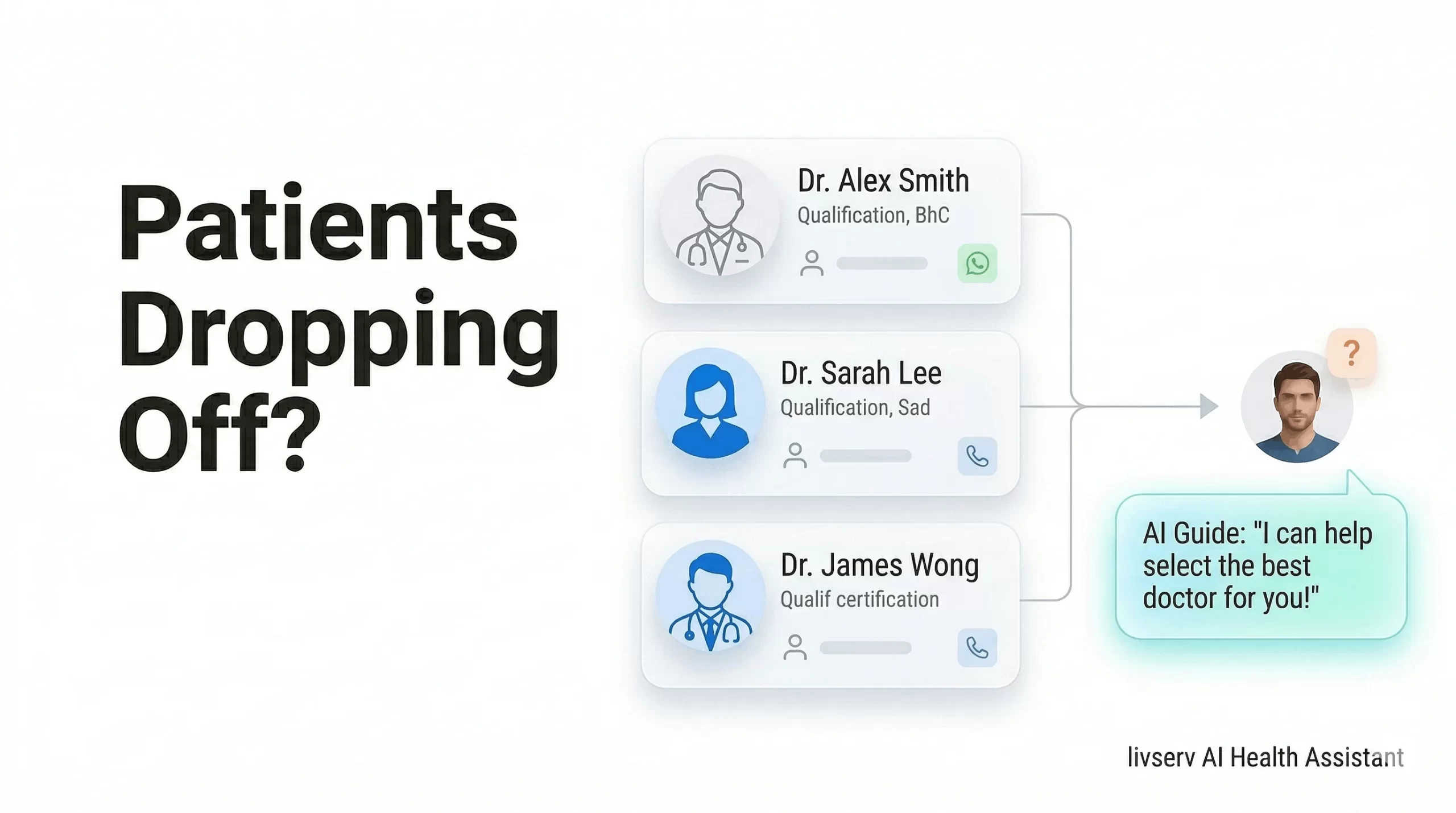
    They see multiple specialties. Neurology. General Medicine. ENT.

    Then they see multiple doctors under each category.

    Different names. Different experience levels. No clear guidance.

    They pause.

    They hesitate.

    They leave.

    No appointment booked.

    This is not a traffic problem. This is a decision-stage drop-off.


    The Hidden Drop-Off in Healthcare Funnels

    The typical patient journey looks simple:

    Symptom → Search → Doctor Selection → Appointment Booking → Visit

    But the biggest drop-off happens here:

    Doctor Selection → Appointment Booking

    This stage is critical because:

    • The patient has intent
    • They are actively looking for care
    • They are close to booking

    Yet, most hospitals fail at this exact moment.


    Why Patients Drop During Doctor Selection

    1. Specialty Confusion

    Patients are not medical experts.

    They don’t always know whether their problem requires a cardiologist, neurologist, or general physician.

    When presented with multiple departments, they feel uncertain.

    Uncertainty leads to inaction.

    Instead of choosing the wrong doctor, patients choose nothing.


    2. Lack of Real-Time Availability

    Even if a patient selects a doctor, the next question is immediate:

    “When can I get an appointment?”

    If availability is not visible:

    • Patients assume delays
    • They postpone booking
    • They look for alternatives

    Delay kills intent.


    3. No Guided Decision Support

    Most hospital websites are static.

    They list doctors but don’t guide patients.

    There is no system to:

    • Understand symptoms
    • Recommend the right doctor
    • Simplify decision-making

    Without guidance, patients feel lost.


    4. Slow Response from Hospital Staff

    Some patients try to call.

    Others fill out forms.

    But:

    • Calls go unanswered
    • Responses are delayed
    • Follow-ups are inconsistent

    In healthcare, speed builds trust. Delay breaks it.


    5. Friction in Appointment Booking

    Booking often involves:

    • Filling long forms
    • Waiting for confirmation
    • Manual coordination

    For a patient already anxious, this is too much effort.

    Friction reduces conversions.


    Impact on Hospitals

    These gaps are not small problems.

    They directly affect business outcomes:

    • Lost patients: High-intent users leave without booking
    • Lower appointment rates: Funnel leakage increases
    • Operational inefficiency: Staff handles repetitive queries
    • Revenue loss: Fewer consultations mean lower revenue

    You are not losing traffic. You are losing ready-to-book patients.


    How AI Chatbots Solve This Problem

    An AI chatbot for healthcare acts as a real-time patient assistant.

    It guides, informs, and converts patients at the exact moment they need help.


    1. Smart Doctor Recommendations

    Instead of showing a static list, the chatbot asks simple questions:

    • What symptoms are you experiencing?
    • How long have you had them?

    Based on responses, it:

    • Identifies the right specialty
    • Recommends suitable doctors

    This removes confusion and builds confidence.


    2. Real-Time Availability Display

    The chatbot shows:

    • Available time slots
    • Next available appointments

    Instant visibility removes uncertainty.

    Patients can act immediately.


    3. Instant Appointment Booking

    Patients can:

    • Select a doctor
    • Choose a time slot
    • Confirm booking instantly

    No forms. No waiting. No friction.


    4. 24/7 Patient Engagement

    The chatbot works round the clock.

    Whether it’s midnight or early morning:

    • Patients get instant responses
    • No query goes unanswered

    This ensures no patient is lost due to timing.


    5. Personalized Patient Journey

    The chatbot remembers:

    • Patient preferences
    • Previous interactions

    It delivers:

    • Personalized recommendations
    • Relevant follow-ups

    This creates a guided, human-like experience.


    Real-World Scenario: Before vs After AI

    Before AI Chatbot

    Patient visits website → sees multiple doctors → gets confused → leaves

    Result: No booking

    After AI Chatbot

    Patient visits website → chatbot asks symptoms → recommends doctor → shows availability → books instantly

    Result: Appointment confirmed


    How Livserv.ai Helps Healthcare Providers

    Livserv.ai is an AI chatbot platform that helps healthcare providers automate patient engagement and appointment booking.

    It enables:

    • Real-time patient interaction
    • Automated appointment scheduling
    • Smart doctor recommendations
    • Integration with website and WhatsApp

    It bridges the gap between patient intent and conversion.


    Benefits for Hospitals

    • Increased appointments: More patients complete booking
    • Improved patient experience: Faster, guided journeys
    • Reduced workload: Automation handles repetitive queries
    • Higher conversion rates: Better funnel efficiency

    FAQs

    Why do patients drop during doctor selection?

    Patients face confusion, lack of guidance, and delayed responses, leading to hesitation and drop-offs.

    What is a healthcare chatbot?

    A healthcare chatbot is an AI-powered system that helps patients with queries, doctor selection, and appointment booking.

    How can hospitals improve appointment booking?

    By reducing friction, offering real-time availability, and guiding patients using AI chatbots.

    Are AI chatbots safe for healthcare?

    Yes, when implemented with proper compliance and data security standards.

    Can chatbots replace hospital staff?

    No, they assist staff by handling repetitive tasks and improving efficiency.

    Do chatbots work on WhatsApp?

    Yes, many healthcare chatbots integrate with WhatsApp for better patient engagement.


    Conclusion: The Moment That Defines Conversion

    Patients don’t drop because they are not interested.

    They drop because they are not guided.

    The doctor selection stage is where:

    • confusion peaks
    • decisions slow down
    • patients leave

    AI chatbots solve this by guiding patients instantly and intelligently.

    When you remove confusion and friction, you don’t just improve experience.

    You increase appointments, conversions, and revenue.

    The question is not whether patients are coming.

    The question is whether you are ready to convert them.

  • Why Real Estate Buyers Drop After Shortlisting Properties

    Why Real Estate Buyers Drop After Shortlisting Properties

    The Most Expensive Lead You’re Losing

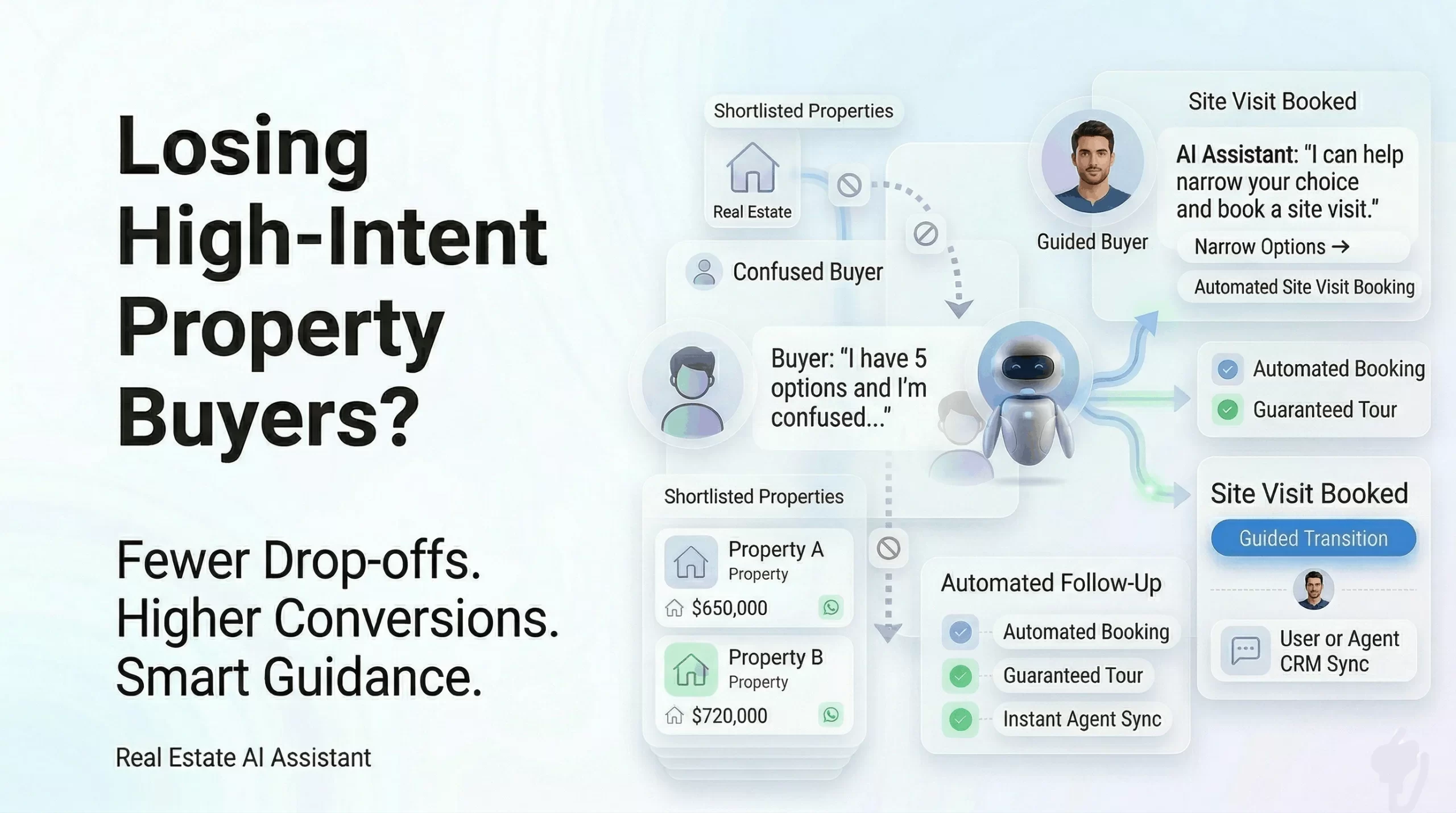
    A potential buyer lands on your website. They browse multiple properties, compare options, and shortlist a few.

    This is not a casual visitor. This is a high-intent buyer.

    They are close to making a decision. But instead of booking a site visit, they leave.

    No call. No inquiry. No conversion.

    This is one of the biggest hidden revenue leaks in real estate.

    The Most Critical Drop-Off Stage in Real Estate

    The real estate buyer journey looks simple:

    Browse → Shortlist → Compare → Site Visit → Purchase

    But the biggest drop-off happens between:

    Property Shortlisting → Site Visit Booking

    This stage is critical because:

    • The buyer has already shown strong interest
    • They are actively evaluating options
    • They are closest to conversion

    Yet, most businesses fail to convert at this point.

    Understanding Buyer Psychology at the Shortlisting Stage

    At this stage, buyers are not asking “Should I buy?”

    They are asking:

    • Which property is better?
    • Am I making the right decision?
    • What if I miss a better option?

    This creates decision pressure, confusion, and hesitation.

    If businesses don’t guide them at this moment, buyers delay or leave.

    Why High-Intent Buyers Drop Off (Deep Breakdown)

    1. Decision Paralysis from Too Many Options

    Buyers compare multiple properties across price, location, amenities, and future value.

    This creates cognitive overload.

    When overwhelmed, buyers don’t decide — they delay.

    Without guidance, confusion increases and conversion drops.

    2. Unanswered Micro-Doubts

    Buyers at this stage have very specific questions:

    • Is this unit available?
    • What is the final price?
    • What are the exact amenities?
    • What is the possession timeline?

    These are small doubts, but they have a big impact.

    Unanswered doubts reduce confidence and kill momentum.

    3. Friction in Site Visit Booking

    Most businesses still rely on:

    • Forms
    • Manual calls
    • Delayed coordination

    For a buyer ready to act, this feels like unnecessary effort.

    Even small friction leads to drop-offs.

    4. Lack of Instant Engagement

    Real estate decisions are time-sensitive.

    If buyers don’t get instant responses:

    • Interest drops
    • Attention shifts
    • Competitors win

    The fastest responder wins the deal.

    5. No Follow-Up on Shortlisted Properties

    Most businesses don’t track user behavior.

    So follow-ups are generic instead of personalized.

    Generic follow-ups get ignored.

    What This Drop-Off Is Costing Your Business

    You are losing:

    • High-quality buyers
    • Marketing investment
    • Site visit opportunities
    • Revenue potential

    You’re not losing traffic. You’re losing buyers who were ready.

    How Livserv AI Chatbot Solves Real Real Estate Challenges

    Real estate problems are not generic. They are complex and happen across the entire funnel.

    Livserv AI chatbot is designed to solve these real challenges end-to-end.

    1. Solving Low-Quality Lead Problem

    Instead of capturing raw leads, the chatbot:

    • Asks qualifying questions (budget, location, timeline)
    • Segments users into hot, warm, and cold leads
    • Passes only high-intent leads to sales teams

    This improves sales efficiency and conversion rates.

    2. Solving Property Comparison Confusion

    The chatbot acts like a digital property advisor.

    It:

    • Compares shortlisted properties
    • Highlights key differences
    • Recommends best-fit options

    This reduces confusion and accelerates decisions.

    3. Solving Site Visit Booking Friction

    Instead of manual processes, buyers can:

    • Select date and time instantly
    • Book visits in one click

    No delays. No back-and-forth.

    4. Solving Slow Response Problem

    The chatbot provides:

    • Instant answers to queries
    • 24/7 availability
    • Simultaneous conversations

    This ensures no buyer waits.

    5. Solving Follow-Up Gaps

    The chatbot tracks behavior and sends:

    • Personalized reminders
    • Relevant property suggestions
    • Site visit nudges

    This keeps buyers engaged until conversion.

    6. Solving Sales Context Problem

    Sales teams get complete insights:

    • Viewed properties
    • User preferences
    • Interaction history

    This makes conversations more effective and personalized.

    7. Solving ROI Problem

    The chatbot:

    • Improves lead-to-visit conversion
    • Maximizes existing traffic
    • Reduces wasted ad spend

    More conversions without increasing budget.

    8. Solving Decision-Stage Drop-Off

    The chatbot engages exactly when:

    • buyers shortlist properties
    • confusion peaks

    It provides:

    • Guidance
    • Answers
    • Instant booking

    This is where maximum revenue is recovered.

    9. Solving Multi-Channel Communication Issues

    The chatbot integrates across:

    • Website
    • WhatsApp

    Providing a consistent experience everywhere.

    10. Solving Scalability Challenges

    Instead of hiring more agents:

    • The chatbot handles thousands of conversations
    • Works without human limitations

    Scale without increasing cost.

    Before vs After Using AI Chatbot

    StageWithout AIWith AI
    ShortlistingPassiveGuided
    QueriesDelayedInstant
    BookingManualAutomated
    Follow-UpsGenericPersonalized
    ConversionLowHigh

    Final Insight: AI Chatbot Is a Sales Engine, Not Just a Tool

    Most businesses think chatbots are for support.

    But in reality:

    They are a conversion engine.

    They solve gaps in:

    • speed
    • decision-making
    • engagement
    • follow-ups

    Conclusion: You Don’t Need More Leads

    You already have buyers who are ready.

    The problem is:

    You are missing the moment when they need you most.

    High intent doesn’t last forever.

    Every delay creates doubt.

    And buyers don’t wait — they move on.

    Fix the gap between shortlisting and site visit booking, and you unlock massive revenue potential.