Use Canned Responses and Upload Training Documents features tactically to your advantage while building a unique persona for your AI Chatbot.
In the bustling world of digital marketing, if attention is your currency, engagement is your reward. And what better way to grab it than with new conversational AI chatbots?
But beyond the technical limitations, the true magic lies in crafting a personality that resonates with your target audience. Think of it as casting the perfect role for a play – the right traits, tone, and quirks can make your chatbot an audience favorite.
Fortunately, Livserv AI chatbot builder offers personalized training modules via simple document upload that optimizes your AI chatbot’s personality to suit your target audience.
Let’s dive down further.
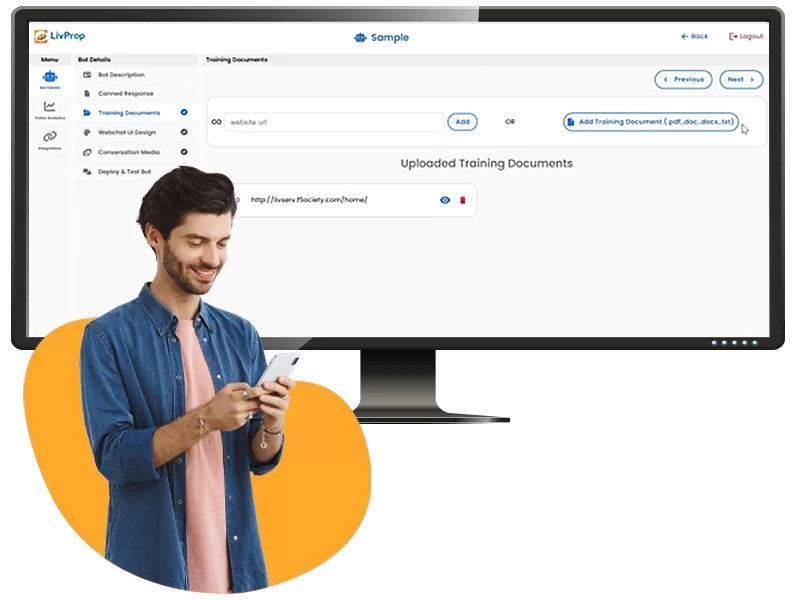
Image: Training responses of Livserv.ai dashboard
Build AI Persona That Clicks With Your Target Demographic
Here’s your playbook to build a unique AI chatbot personality:
Know Your Audience Inside-Out: Before you decide on AI chatbot functionality, delve deep into the minds of your target users. What are their interests, pain points, and communication styles? Do they prefer playful banter or professional formality? Understanding their language, humor, and expectations is key to building a connection.
Define Your Brand Voice: Think of your chatbot as the digital embodiment of your brand. Does it reflect your values, mission, and overall tone? Is it the quirky friend, the helpful guide, or the sassy expert? Defining your brand voice helps guide the chatbot’s personality development.
Strike the Right Tone: Just like in real conversations, tone sets the stage for engagement. Do you want a lighthearted and informal approach, or a more authoritative and informative one? Remember, the tone should align with your audience and brand voice.
Inject Personality Potions: Give your chatbot a sprinkling of quirks and charm! Does it have a favorite emoji? Does it get me excited about certain topics? These little personality nuances can make your chatbot feel more human and relatable.
Train on Real Conversations: Let the data be your guide! Analyze real conversations with your target audience to understand their language patterns, humor preferences, and common questions. This valuable data will feed the AI, fine-tuning its responses and making it sound more natural.
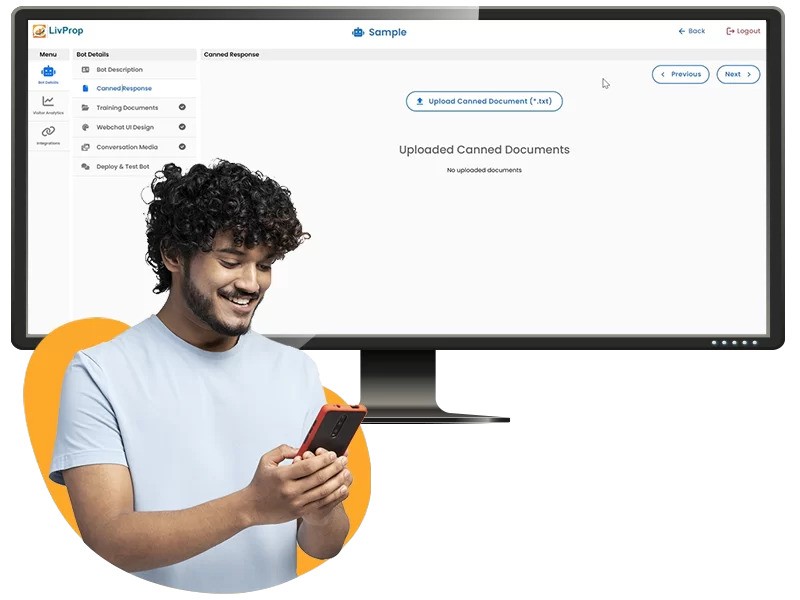
Livserv AI chatbot builder provides options like canned response or training through simple .pdf upload or webpage URL, and more to align responses with your brand value and expectations.
Image: Uploading Canned responses using the Livserv dashboard
Test and Tweak: Just like any good performance, your chatbot personality needs refinement. Continuously test its responses with real users, gather feedback, and iterate on its personality. Remember, the perfect persona is a work in progress.
Unleash the Chatty Charm: Once your AI has mastered the art of conversation, let it loose on the world! Encourage interaction through engaging prompts, answer questions with wit and expertise, and make users feel like they’re chatting with a friendly (albeit digital) acquaintance.
Remember, a captivating AI personality isn’t just about technology – it’s about understanding your audience, embodying your brand, and injecting a touch of human charm.
By following these tips, you can train an AI chatbot that not only stands out from the crowd but also builds meaningful connections with your target audience.
An overview of the inefficiencies of common contact center tools and how they compare against Livserv’s conversational AI chatbot.
Many contact centers use outdated tools. Common contact center tools such as ticketing systems, CRMs, shared mailboxes, and spreadsheets are inefficient and time-consuming.
These systems lack post-sales features and overviews of customer history. Channel choices and reports are limited, and omnichannel customer service is impossible. Lack of automation means that agents have to enter and organize data manually.
With CRMs, agents waste time dialing and waiting for contacts to answer. With spreadsheet systems, agents spend more time entering information than analyzing and benefiting from it.
Livserv collects data from all channels and integrates it with the CRM, if necessary. If you still want to use ticketing for complex cases requiring a specialist, Livserv also integrates with ticketing systems.
The Livserv provides the ability to qualify and nurture leads so that your tele-callers can spend more time selling instead of dialing and waiting.
Finally, unlike the alternatives, the Livserv AI chatbot builder is also easily scalable and seamlessly fits a business’s growth.
Feature
SPREADSHEETS
SHARED MAILBOX
TICKETING SYSTEM
CRM SYSTEM
LIVSERV
Fast Implementation
YES ✅
YES ✅
Maybe
No
YES ✅
Scalability
NO
NO
YES
YES
YES ✅
Automated data entry
NO
NO
YES
YES
YES ✅
Omnichannel
NO
NO
NO
NO
YES ✅
Personalized service
NO
NO
NO
NO
YES ✅
Conversational history
NO
NO
NO
NO
YES ✅
Livserv vs. a CRM System
AI Chatbots: These virtual assistants engage in real-time conversations with customers via websites, mobile apps, or messaging platforms.
CRM Systems: These customer relationship management tools store and manage customer data, track interactions, and facilitate sales and marketing efforts.
Why store your customers in a database if you can’t contact them at the right time, every time?
Both AI chatbots and CRM systems have their strengths and weaknesses in contact center automation. Ultimately, the best choice depends on your specific needs and priorities.
For immediate, personalized customer interactions and omnichannel support, AI chatbots shine. They excel at guiding customers through purchase journeys, collecting valuable data, and providing 24/7 support.
For in-depth customer data analysis, segmentation, and personalized sales follow-up, CRM systems hold the edge. They can help tailor marketing campaigns, predict customer needs, and improve sales efficiency.
Feature
AI Chatbot
CRM Systems
Immediate Interaction
⛔ Initial setup and customization costs can be high, and ongoing maintenance required.
⛔ Primarily asynchronous communication, require human agent follow-up.
Personalization
✅ Leverage NLP to understand customer intent and personalize responses based on purchase history, preferences, and past interactions.
✅ Segment customers based on demographics, purchase behavior, and other data points, but personalization requires manual effort.
Conversion Optimization
✅ Offer 24/7 real-time support, handle FAQs and collect leads.
✅ Provide sales reps with customer data and purchase history to personalize interactions, but rely on human skills for conversion.
Omnichannel Support
✅ Integrate seamlessly across website, mobile app, and messaging platforms for consistent customer experience.
⛔ Siloed data makes omnichannel support challenging, requiring integration with other systems.
Data Storage & Analysis
✅ Collect valuable customer data through conversations, but may lack sophisticated analysis tools.
✅ Robust data storage and analysis capabilities, but lack real-time insights from customer interactions.
Scalability & Cost
✅ Highly scalable and cost-effective compared to human agents.
⛔ Initial setup and customization costs can be high, and ongoing maintenance is required.
The most effective solution often lies in a hybrid approach that combines the strengths of both technologies. Integrate your AI chatbot with your CRM system to:
Enrich customer data: Feed information collected by the chatbot into the CRM for deeper customer insights.
Trigger targeted actions: Use CRM data to personalize chatbot responses and trigger relevant marketing campaigns.
Handoff seamlessly: Transfer complex inquiries from chatbot to human agents within the CRM for smooth escalation.
Livserv vs. a Ticketing System
Ticketing systems have been the workhorses of contact centers for years. They offer a structured approach to handling inquiries through a centralized platform, clear workflow, and maintain detailed records.
However, ticketing systems have their limitations:
Impersonal experience: Interactions feel mechanical and lack the human touch, potentially frustrating customers.
Time-consuming resolution: Waiting for tickets to be assigned and resolved can lead to customer dissatisfaction.
Limited self-service: Customers often have to wait for agent assistance, even for simple tasks.
AI chatbots bring a new level of engagement and efficiency to contact centers:
Real-time conversations: Chatbots engage customers in natural dialogue, providing immediate support and resolving simple issues quickly.
24/7 availability: Chatbots never sleep, offering round-the-clock support, even outside business hours.
Personalized interactions: Chatbots leverage AI and NLP to understand customer intent and personalize responses, creating a more satisfying experience.
Self-service empowerment: Chatbots can answer FAQs, guide customers through processes, and offer self-service options, reducing agent workload.
Livserv vs. Shared Mailbox
Both chatbots and shared mailboxes have their place in the customer service ecosystem. The ideal solution lies in a strategic orchestration of both technologies. Consider these factors:
Customer complexity: For inquiries and self-service, conversational AI shines. For complex issues, human expertise is still crucial.
Resource availability: AI Chatbots can free up agents for more demanding tasks, but implementation may require initial investment.
Brand personality: AI Chatbots can be branded and personalized to fit your company’s tone and values.
Implement chatbots to automate routine tasks and personalize interactions, but seamlessly integrate human agents when needed.
Livserv vs. Spreadsheet
Spreadsheets, especially Microsoft Excel, used to be the standard tool for organizing call center operations. With the emergence and evolution of quality call center software, there’s no reason to use spreadsheets in sales anymore!
Listing out eight key categories for effectively monitoring and optimizing the success of your Conversational AI chatbot.
Conversational AI chatbots have become a cornerstone for businesses aiming to enhance customer engagement and streamline operations. These intelligent systems are designed to interact with users in a natural language format, providing information, assistance, and even completing transactions.
While the implementation of a chatbot is a crucial step, measuring its success is equally important for optimizing its performance and ensuring a positive user experience.
In this blog, we will delve into key metrics and strategies to effectively measure the success of your Conversational AI chatbot.
Key Categories of Chatbot Metrics
Your chatbot’s success can be measured across diverse categories, each offering valuable insights. Let’s explore some key categories:
User Engagement Metrics
1. Interaction Volume 2. User Retention 3. Session Duration
Accuracy and Effectiveness Metrics
1. Intent Recognition 2. Response Accuracy
User Satisfaction Metrics
1. Customer Feedback 2. Net Promoter Score (NPS)
Operational Metrics
1. Resolution Rate 2. Escalation Rate
Technical Metrics
1. Uptime and Reliability 2. Response Time
Conversation Flow Metrics
1. User Drop-off Rate 2. Conversation Completion Rate
Integration Metrics
1. Cross-Channel Consistency
Adaptability and Learning Metrics
1. Training Data Updates 2. Adaptation to New Scenarios
Key metrics for measuring the success of your AI chatbots
User Engagement Metrics:
a. Interaction Volume:Track the total number of interactions to understand the overall engagement levels.
For example, a retail business implements a chatbot to handle customer queries. During the holiday season, the interaction volume spikes, indicating high user engagement as customers seek information about promotions, product availability, and order statuses.
b. User Retention: Measure how many users return for subsequent interactions, indicating the bot’s ability to retain an audience.
For example, An e-learning platform deploys a chatbot to assist students with course-related queries. High user retention is observed as students return to the chatbot for ongoing support, indicating the chatbot’s effectiveness in providing timely assistance.
c. Session Duration: Analyze the average time users spend in a conversation to gauge the effectiveness of the chatbot in providing valuable information promptly.
For example, a travel agency employs a chatbot to help users plan vacations. Longer session durations are observed as users engage in detailed conversations about travel itineraries, accommodations, and local attractions.
Accuracy and Effectiveness Metrics:
a. Intent Recognition: Assess the chatbot’s ability to accurately identify user intents, ensuring that it understands and responds appropriately.
For example, a banking institution uses a chatbot for customer service. Advanced intent recognition ensures that the chatbot accurately identifies user queries about account balances, transaction history, and fund transfers.
b. Response Accuracy: Measure the accuracy of responses provided by the chatbot to ensure that users receive relevant and correct information.
For example, an e-commerce platform’s chatbot provides product information and assistance. Regular assessments reveal a high response accuracy rate, ensuring users receive correct details about products and promotions.
User Satisfaction Metrics:
a. Customer Feedback: Collect and analyze user feedback to understand their satisfaction levels and identify areas for improvement.
For example: A healthcare provider implements a chatbot for appointment scheduling and health inquiries. User feedback indicates high satisfaction, with positive comments highlighting the chatbot’s convenience and responsiveness.
b. Net Promoter Score (NPS): Implement surveys or questionnaires to calculate the NPS, giving insight into how likely users are to recommend the chatbot to others.
For example, a telecommunications company integrates a chatbot into its customer support system. Calculating the NPS reveals that a majority of users would recommend the chatbot to friends and family based on its efficiency in resolving queries.
Operational Metrics:
a. Resolution Rate: Track the percentage of user queries resolved by the chatbot without human intervention.
For example, an insurance company employs a chatbot for claim processing. Monitoring the resolution rate shows that the chatbot successfully handles routine claims, freeing up human agents to focus on more complex cases.
b. Escalation Rate: Monitor the number of conversations that require escalation to human agents, indicating the bot’s limitations and areas for improvement.
For example, an e-commerce chatbot monitors user interactions. Analyzing the escalation rate helps identify areas where the chatbot struggles, prompting targeted improvements in those specific functionalities.
Technical Metrics:
a. Uptime and Reliability: Ensure the chatbot is available and operational at all times, minimizing downtime that could affect user experience.
For example, a financial services chatbot operates 24/7 to assist users with account inquiries and financial advice. High uptime and reliability ensure users have continuous access to the chatbot’s services.
b. Response Time: Measure the time it takes for the chatbot to respond, optimizing for speed and efficiency.
For example, a real estate chatbot assists users in property searches. Optimizing response time ensures users receive timely information about property listings and market trends.
Conversation Flow Metrics:
a. User Drop-off Rate: Identify points in the conversation where users disengage or drop off, addressing potential pain points in the user journey.
For example, a tech support chatbot identifies user drop-off points during troubleshooting sessions. Adjustments are made to address common user concerns and improve the overall flow of technical support interactions.
b. Conversation Completion Rate: Track the percentage of conversations that are completed, providing insights into the chatbot’s overall effectiveness.
For example, a banking chatbot assists users in setting up new accounts. Monitoring the conversation completion rate helps identify steps in the process that may cause users to abandon account setup.
Integration Metrics:
a. Cross-Channel Consistency: Ensure a seamless experience across different channels (web, mobile, social media) by monitoring consistency in responses and interactions.
For example, an e-commerce chatbot seamlessly integrates with the company’s mobile app, website, and social media platforms. Consistency in responses and user experience across channels contributes to a unified brand image.
Adaptability and Learning Metrics:
a. Training Data Updates: Regularly update the chatbot’s training data to improve its understanding of user queries and stay relevant over time.
For example, a chatbot used in the tech industry is regularly updated with the latest information about emerging technologies. This ensures the chatbot remains relevant and can provide users with the most current insights.
b. Adaptation to New Scenarios: Evaluate the chatbot’s ability to handle new or evolving scenarios, gauging its adaptability and learning capabilities.
For example, an insurance chatbot encounters a new policy type. The chatbot’s ability to adapt is tested as it learns to handle queries related to the new policy, showcasing its flexibility in accommodating evolving scenarios.
Wrapping Up
Effectively measuring the success of your Conversational AI chatbot involves a comprehensive analysis of user engagement, accuracy, satisfaction, operational efficiency, technical performance, conversation flow, integration capabilities, and adaptability.
Regularly monitoring these metrics, gathering user feedback, and implementing necessary improvements will contribute to the ongoing success of your chatbot, ensuring it remains a valuable asset in enhancing user experiences and achieving business objectives.
Proudly, Livserv is one robust AI chatbot solution that lets you measure almost all the metrics discussed above. We are offering full access to the product until March 2024 for all those who register before January 2024. Limited-time offer. Hurry! Sign up here to claim.
Listing out eight key categories for effectively monitoring and optimizing the success of your Conversational AI chatbot.
Conversational AI chatbots have become a cornerstone for businesses aiming to enhance customer engagement and streamline operations. These intelligent systems are designed to interact with users in a natural language format, providing information, assistance, and even completing transactions.
While the implementation of a chatbot is a crucial step, measuring its success is equally important for optimizing its performance and ensuring a positive user experience.
In this blog, we will delve into key metrics and strategies to effectively measure the success of your Conversational AI chatbot.
Key Categories of Chatbot Metrics
Your chatbot’s success can be measured across diverse categories, each offering valuable insights. Let’s explore some key categories:
User Engagement Metrics
1. Interaction Volume 2. User Retention 3. Session Duration
Accuracy and Effectiveness Metrics
1. Intent Recognition 2. Response Accuracy
User Satisfaction Metrics
1. Customer Feedback 2. Net Promoter Score (NPS)
Operational Metrics
1. Resolution Rate 2. Escalation Rate
Technical Metrics
1. Uptime and Reliability 2. Response Time
Conversation Flow Metrics
1. User Drop-off Rate 2. Conversation Completion Rate
Integration Metrics
1. Cross-Channel Consistency
Adaptability and Learning Metrics
1. Training Data Updates 2. Adaptation to New Scenarios
Key metrics for measuring the success of your AI chatbots
User Engagement Metrics:
a. Interaction Volume:Track the total number of interactions to understand the overall engagement levels.
For example, a retail business implements a chatbot to handle customer queries. During the holiday season, the interaction volume spikes, indicating high user engagement as customers seek information about promotions, product availability, and order statuses.
b. User Retention: Measure how many users return for subsequent interactions, indicating the bot’s ability to retain an audience.
For example, An e-learning platform deploys a chatbot to assist students with course-related queries. High user retention is observed as students return to the chatbot for ongoing support, indicating the chatbot’s effectiveness in providing timely assistance.
c. Session Duration: Analyze the average time users spend in a conversation to gauge the effectiveness of the chatbot in providing valuable information promptly.
For example, a travel agency employs a chatbot to help users plan vacations. Longer session durations are observed as users engage in detailed conversations about travel itineraries, accommodations, and local attractions.
Accuracy and Effectiveness Metrics:
a. Intent Recognition: Assess the chatbot’s ability to accurately identify user intents, ensuring that it understands and responds appropriately.
For example, a banking institution uses a chatbot for customer service. Advanced intent recognition ensures that the chatbot accurately identifies user queries about account balances, transaction history, and fund transfers.
b. Response Accuracy: Measure the accuracy of responses provided by the chatbot to ensure that users receive relevant and correct information.
For example, an e-commerce platform’s chatbot provides product information and assistance. Regular assessments reveal a high response accuracy rate, ensuring users receive correct details about products and promotions.
User Satisfaction Metrics:
a. Customer Feedback: Collect and analyze user feedback to understand their satisfaction levels and identify areas for improvement.
For example: A healthcare provider implements a chatbot for appointment scheduling and health inquiries. User feedback indicates high satisfaction, with positive comments highlighting the chatbot’s convenience and responsiveness.
b. Net Promoter Score (NPS): Implement surveys or questionnaires to calculate the NPS, giving insight into how likely users are to recommend the chatbot to others.
For example, a telecommunications company integrates a chatbot into its customer support system. Calculating the NPS reveals that a majority of users would recommend the chatbot to friends and family based on its efficiency in resolving queries.
Operational Metrics:
a. Resolution Rate: Track the percentage of user queries resolved by the chatbot without human intervention.
For example, an insurance company employs a chatbot for claim processing. Monitoring the resolution rate shows that the chatbot successfully handles routine claims, freeing up human agents to focus on more complex cases.
b. Escalation Rate: Monitor the number of conversations that require escalation to human agents, indicating the bot’s limitations and areas for improvement.
For example, an e-commerce chatbot monitors user interactions. Analyzing the escalation rate helps identify areas where the chatbot struggles, prompting targeted improvements in those specific functionalities.
Technical Metrics:
a. Uptime and Reliability: Ensure the chatbot is available and operational at all times, minimizing downtime that could affect user experience.
For example, a financial services chatbot operates 24/7 to assist users with account inquiries and financial advice. High uptime and reliability ensure users have continuous access to the chatbot’s services.
b. Response Time: Measure the time it takes for the chatbot to respond, optimizing for speed and efficiency.
For example, a real estate chatbot assists users in property searches. Optimizing response time ensures users receive timely information about property listings and market trends.
Conversation Flow Metrics:
a. User Drop-off Rate: Identify points in the conversation where users disengage or drop off, addressing potential pain points in the user journey.
For example, a tech support chatbot identifies user drop-off points during troubleshooting sessions. Adjustments are made to address common user concerns and improve the overall flow of technical support interactions.
b. Conversation Completion Rate: Track the percentage of conversations that are completed, providing insights into the chatbot’s overall effectiveness.
For example, a banking chatbot assists users in setting up new accounts. Monitoring the conversation completion rate helps identify steps in the process that may cause users to abandon account setup.
Integration Metrics:
a. Cross-Channel Consistency: Ensure a seamless experience across different channels (web, mobile, social media) by monitoring consistency in responses and interactions.
For example, an e-commerce chatbot seamlessly integrates with the company’s mobile app, website, and social media platforms. Consistency in responses and user experience across channels contributes to a unified brand image.
Adaptability and Learning Metrics:
a. Training Data Updates: Regularly update the chatbot’s training data to improve its understanding of user queries and stay relevant over time.
For example, a chatbot used in the tech industry is regularly updated with the latest information about emerging technologies. This ensures the chatbot remains relevant and can provide users with the most current insights.
b. Adaptation to New Scenarios: Evaluate the chatbot’s ability to handle new or evolving scenarios, gauging its adaptability and learning capabilities.
For example, an insurance chatbot encounters a new policy type. The chatbot’s ability to adapt is tested as it learns to handle queries related to the new policy, showcasing its flexibility in accommodating evolving scenarios.
Wrapping Up
Effectively measuring the success of your Conversational AI chatbot involves a comprehensive analysis of user engagement, accuracy, satisfaction, operational efficiency, technical performance, conversation flow, integration capabilities, and adaptability.
Regularly monitoring these metrics, gathering user feedback, and implementing necessary improvements will contribute to the ongoing success of your chatbot, ensuring it remains a valuable asset in enhancing user experiences and achieving business objectives.
Proudly, Livserv is one robust AI chatbot solution that lets you measure almost all the metrics discussed above. We are offering full access to the product until March 2024 for all those who register before January 2024. Limited-time offer. Hurry! Sign up here to claim.
Chatbots are diminishing ROI, human agents come at a price. Conversational AI is the best foot forward for customer engagement and lead generation.
Chatbots have been widely hailed as a game-changer for businesses, offering cost-effective automation, 24/7 customer support, and improved efficiency. However, the reality is that not all chatbots deliver the expected return on investment (ROI). In some cases, chatbots may even diminish ROI, leaving businesses wondering what went wrong.
In this article, we’ll explore the reasons behind chatbots that underperform and discuss actionable strategies that businesses can implement to maximize their ROI.
The ROI Challenge: Why Chatbots May Underperform
Inadequate User Experience: Chatbots that offer poor user experiences, including generic responses and difficulty in understanding user queries, can drive customers away, resulting in a decreased ROI.
Limited Functionality: Some chatbots are designed with a narrow scope, capable of handling only basic tasks. This limitation can lead to missed opportunities to engage users and deliver value.
Lack of Personalization: Failing to personalize interactions with users can lead to disengagement and decreased ROI. Users expect tailored responses and relevant recommendations.
Data Privacy Concerns: If chatbots mishandle sensitive information or fail to address data privacy concerns adequately, it can erode trust and harm the ROI.
Real Estate Case Study: How Chatbots are Diminishing your ROI
A recent experience from our competitor analysis revealed related evidence of chatbots unknowingly compromising lead data.
Real estate builders spend huge money on online lead generation and regularly upgrade their CRM process to maintain the confidentiality of the prospects.
However, they are caught unaware of the compromise of lead data in choosing a cheaper chatbot system to attend to website visitors provided by (name undisclosed) and convert them into prospects.
Visitors are expected to browse through a builder’s website or connect directly via Facebook or WhatsApp. They are usually asked to provide contact information in the chat for receiving project details.
As the visitor is still in the initial phase, they browse multiple builder’s websites as well. There is a high chance that they come across competitors in the same area or some project with the same budget and the competitor is using the same chatbot solution on their websites.
During such interactions, the chatbot asks the visitor if it can e-mail all the details. The moment the visitor clicks “YES”, it identifies repeat visitors gathers the contact details from the existing database, and shares the email of the visitor without asking for permission.
In effect, the lead details from the first website as the response are BEING shared with competitors using the same chatbot integration for nurturing the same prospect.
The first builder must have spent a huge money and time in creating interest in the visitor, but the same lead is pulled by the competitor by spending less time and money in the campaign. This is the reason why customers using Chatbot are getting fewer conversions.
Thus, when a chatbot is sold at a cheaper price remember you are getting sold!
Strategies to Improve Chatbot ROI – Switch to Conversational AI
1. Prioritize User Experience: Invest in Natural Language Processing (NLP) and machine learning to enhance your chatbot’s ability to understand and respond to user queries effectively. Create conversational flows that feel more like human interactions, reducing user frustration and abandonment.
2. Extend Functionality: Evaluate your chatbot’s capabilities and expand its functionality. Consider adding features such as e-commerce capabilities, appointment scheduling, or troubleshooting guides, depending on your business model.
3. Personalize Interactions: Implement user profiling and behavior tracking to deliver personalized recommendations and content. Segment users based on their preferences, browsing history, or purchase behavior to tailor chatbot interactions.
4. Prioritize Data Privacy: Invest in robust data encryption and secure communication protocols to protect user data. Clearly communicate your data privacy policies and ensure the chatbot complies with industry-specific regulations.
5. Seamless Integration: Ensure your chatbot seamlessly integrates with your CRM, content management systems, and databases to provide users with accurate and up-to-date information. Implement omnichannel capabilities to maintain a consistent user experience across various platforms.
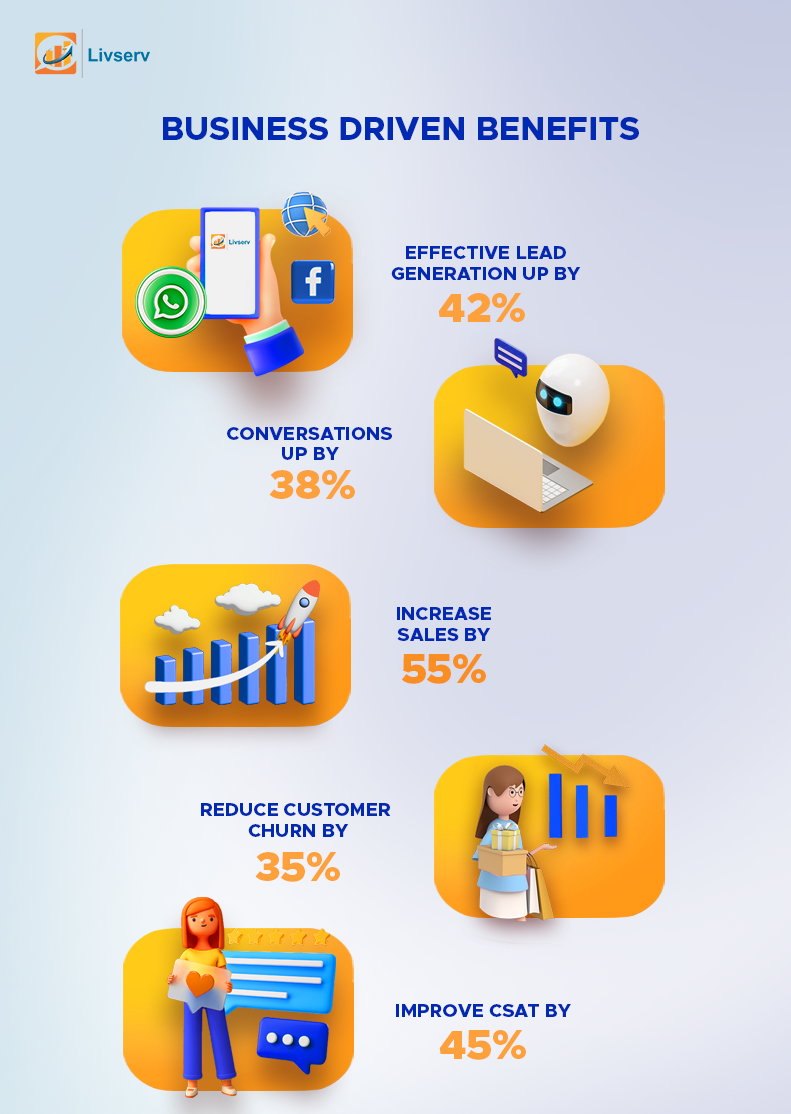
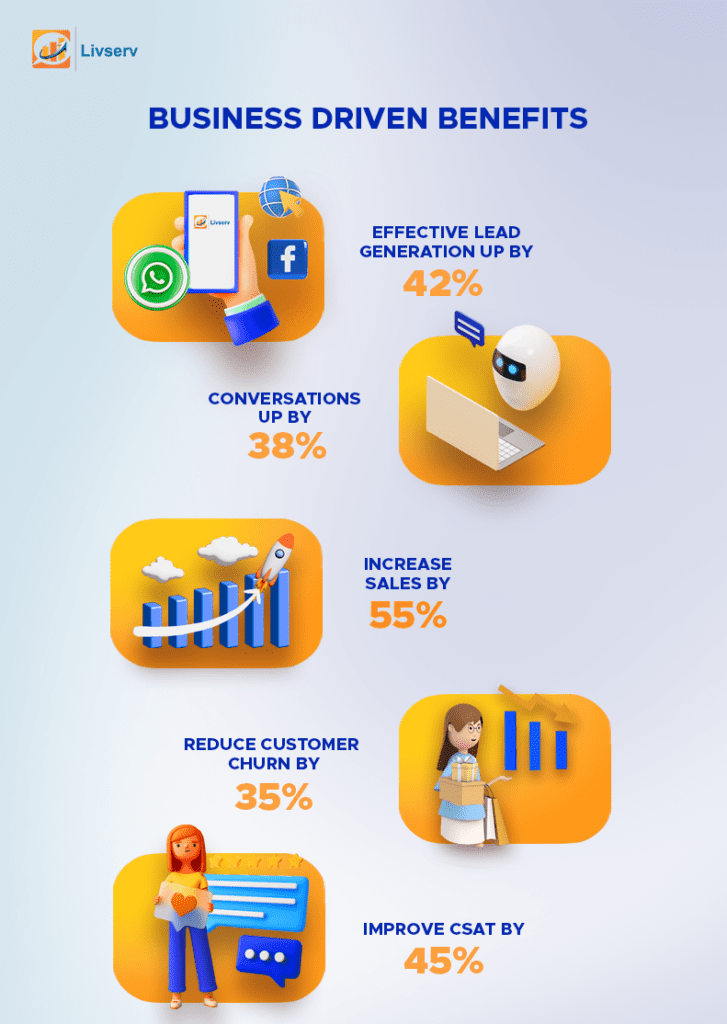
Figure 1: Business-driven Benefits of Conversational AI in Customer Engagement and Lead Generation
Chatbot vs. Conversational AI: What’s the Difference?
While both chatbots and Conversational AI involve automated conversations, the key distinction lies in their capabilities and the level of sophistication. The choice between the two depends on the specific requirements of the application and the level of complexity needed for effective automation.
How is Conversational AI better:
Broad Capabilities: Conversational AI is designed to handle a wide range of conversational tasks and interactions. It’s more versatile and adaptable, making it suitable for various applications, from customer support to virtual assistants.
AI-Powered: Conversational AI leverages advanced artificial intelligence techniques, including natural language processing (NLP), machine learning, and deep learning. These technologies enable it to understand and respond to user input in a more human-like manner.
Context Awareness: Conversational AI systems are context-aware. They can remember past interactions and maintain context throughout a conversation. This enables more coherent and meaningful dialogues.
Intent Recognition: Instead of relying solely on keywords, Conversational AI employs intent recognition to understand what users are trying to accomplish. It can understand and respond to queries, even if they don’t contain explicit keywords.
Machine Learning-Based:Conversational AI continually learns from user interactions. It can adapt and improve its responses over time, providing a more personalized and effective user experience.
How are Chatbots inferior:
Narrow Focus: Chatbots are typically designed for a specific, narrow set of tasks or interactions. They excel at performing pre-defined functions and responding to simple queries. For example, a chatbot on an e-commerce website might help users track orders or answer frequently asked questions.
Rule-Based or Scripted: Many chatbots operate based on predefined rules or scripts. They follow a decision tree or set of if-then-else rules to determine responses. This limits their ability to handle complex or unstructured conversations.
Limited Context Awareness: Chatbots often lack context awareness. They don’t remember past interactions, making it challenging to have natural, ongoing conversations. If you ask a chatbot a follow-up question, it might not remember the context of the previous question.
Relies on Keywords: Keyword recognition is a common method for chatbots to identify user intent. They look for specific keywords in user input to generate relevant responses. This approach can be limiting if the user input doesn’t contain the expected keywords.
Minimal Machine Learning: While some chatbots incorporate basic machine learning for improved performance, they generally lack the advanced natural language processing (NLP) and machine learning capabilities that Conversational AI possesses.
By focusing on user experience, extending functionality, personalizing interactions, ensuring data privacy, and seamless integration, businesses can turn their chatbots into effective tools for enhancing ROI. And this would be possible through conversational AI builders like Livserv.ai
After all, it’s not just about having a chatbot; it’s about having the right chatbot that aligns with your business goals and user expectations.
Overview of how to use Livserv.ai – a 7-step guide to build a conversational AI chatbot for business.
Conversational AI has transformed the way businesses interact with their customers. These intelligent systems, including AI chatbots and virtual assistants, voice bots are revolutionizing lead generation, customer service, automating tasks, and enhancing user experiences.
If you’re eager to explore the world of Conversational AI and build your very first AI-driven conversational agent, this step-by-step guide is your roadmap to success.
Step 1: Define Your Conversational AI’s Purpose
Before you dive into development, it’s crucial to have a clear understanding of why you want to build a Conversational AI.
Ask yourself:
What specific tasks or problems will your AI address? For example, you might discover that your customer support team is overwhelmed with non-intentional inquiries/spam leads, leading to wasteful expenses.
Look for opportunities to improve processes and experiences. Maybe there’s an opportunity to create a 24/7 support system, provide personalized product recommendations, or collect valuable customer feedback.
What are your goals for the AI system? Say, if you’re focused on customer support, an objective might be to reduce response times by 30% within six months.
Having a well-defined purpose will guide your development process and help you measure success. Move to the next step.
Step 2: Choose the Right Provider
Before selecting a provider, you must have a clear understanding of your project’s specific requirements. Consider:
The type of Conversational AI you need (e.g., chatbot, virtual assistant, voice assistant).
The channels where it will be deployed (e.g., website, mobile app, messaging platforms).
The complexity of the conversations it needs to handle.
The languages and regions it must support.
Any regulatory or compliance considerations (e.g., data privacy, industry-specific regulations).
Evaluate the strengths and weaknesses of each provider in relation to your project requirements. One such leading conversational AI builder is Livserv.
Livserv.ai allows you to train ChatGPT on your business data. Later add it to your website, or connect it with your WhatsApp, or Facebook and even integrate it with your existing CRM.
Step 3: Enter Canned Responses
Canned responses are pre-written templates or messages that you can use to quickly respond to common inquiries, messages, or situations.
Figure 1: Entering Canned Responses
To use canned responses effectively on livserv.ai, follow the below steps:
Identify Common Scenarios: These could be customer inquiries, support requests, appointment confirmations, or any other type of frequently occurring communication.
Create Canned Responses: Write and save your canned responses. Craft them to be concise, informative, and adaptable to different situations.
Insert a Canned Response: Look for “Download Templates” to begin and insert canned responses in the same format.
Customize as You Go: Regularly review and update your canned responses to reflect any changes in your business or communication style.
However, personalized communication is crucial for building relationships, so use canned responses in situations only where they genuinely enhance efficiency without sacrificing quality.
Later, add Conversational media. It refers to the use of images, graphics, and videos to enhance and enrich the communication between the chatbot and your prospects.
Livserv.ai allows you to upload upto 8 product images or review videos to generate engagement. You may assign keywords to particular media or responses to make communication more interesting.
Step 4: Develop and Train Your AI
Livserv allows you to upload upto 5 web page links or other training documents. To get the best response, you may upload About Us, Portfolio, Services web pages, Pricing, and other relevant documents.
Figure 2: Training ChatGPT with Business Website URL
Livserv.ai allows you to train documents effectively using the following strategy:
Gather Relevant Content: These could include FAQs, customer interactions, product descriptions, and any other content relevant to your chatbot’s purpose.
Prepare a Clean Dataset: Ensure your training documents are clean and free from unnecessary formatting or special characters that might confuse the model. Remove any sensitive or confidential information.
Format for Training: Format your training documents as plain text files (.txt, .doc or .docx) or .pdf. Each document should ideally be a separate file or a section within a larger file.
Upload Training Documents: This may involve selecting files from your device or providing URLs. A maximum of 5 URLs or documents are allowed.
Initiate Training: The training process within the chatbot builder will begin automatically.
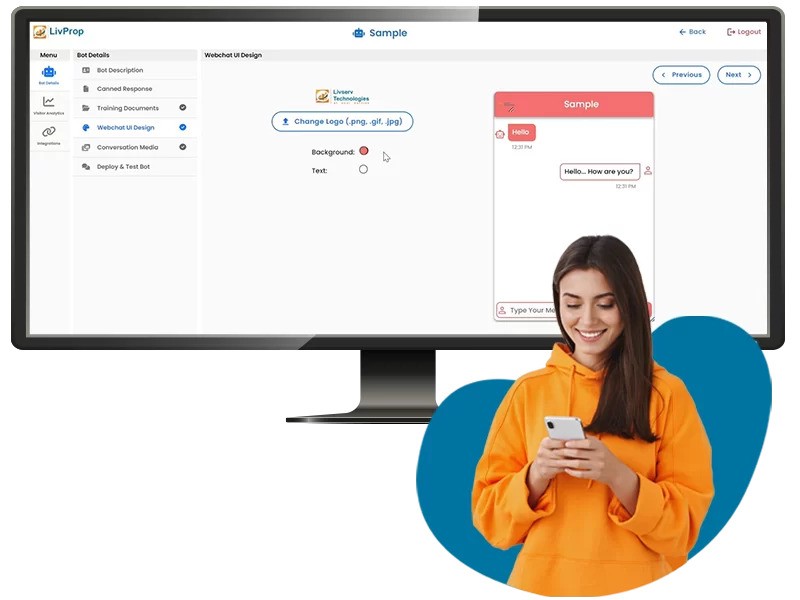
Further, focus on the UI design of the webchat dialog box.
Figure 3: Adjusting UI of Webchat
Livser.ai allows you to upload custom images for the chat window, resize the chat frame depending on desired customer touchpoints, and change the background/text color and font size.
Consistency with your brand’s visual identity and intuitive design choices will create a seamless and enjoyable interaction for users on your website.
Step 5: Integration
Depending on your AI’s purpose, you may need to integrate it with your website, app, or messaging platform like WhatsApp or Facebook. This integration ensures that your users can access your AI where it’s most convenient for them.
Furthermore, you can integrate livserv.ai with your existing CRM. This will help you retarget customers and churn out cold leads.
Before your AI goes live, conduct comprehensive testing. Invite users or team members to interact with your Conversational AI and provide feedback. Look for issues such as misinterpretations, incorrect responses, or other shortcomings. Use this feedback to refine your AI’s conversation flow and responses.
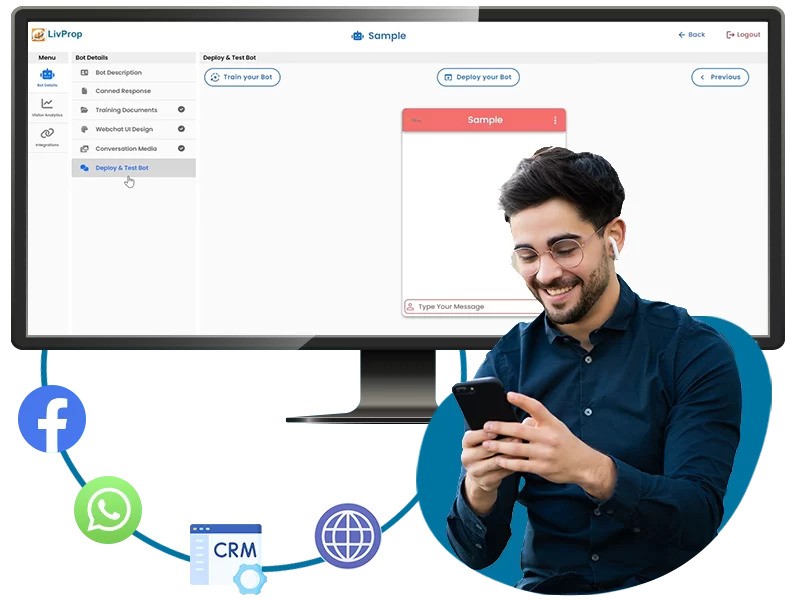
Once you’re satisfied with your AI’s performance, it’s time to deploy it. Make it accessible to users on your chosen platform. Monitor its performance, gather data, and analyze user interactions.
Figure 4: Deploy & Test Bot
Our support is also available 24/7 to help you optimize your AI chatbot to suit your business needs.
Step 7: Continuous Improvement
A Conversational AI is a dynamic tool that requires ongoing attention. Regularly review its performance, analyze user feedback, and make necessary improvements. Update responses, expand its capabilities, and adapt to evolving user needs.
Building your first Conversational AI can be a fulfilling and transformative experience. By following this step-by-step guide, you can create an AI-driven conversational agent that enhances customer engagement and lead generation, streamlines processes and offers valuable insights for your business.
Remember, the key to success is a clear understanding of your AI’s purpose and a commitment to continuous improvement based on user feedback. Welcome to the world of Conversational AI, where the possibilities for enhancing your business are limitless.
We are offering a free trial of our livserv.ai for businesses who wish to boost their online sales and customer engagement. Click here to sign up.
Chatbot has become a highly misappropriated term in our industry. Every other sales call that we attend to, wants an impeccable customer service chatbot that can mimic human-agent-like responses. But what they don’t realize is chatbots are not conversational AI.
Strictly tech, traditional chatbots follow pre-defined rules and decision trees. They provide responses based on keywords or patterns in user input. However, the changing landscape of customer service now warrants marketers to look beyond rule-based chatbots.
The latest AI-powered chatbot uses Natural Language Processing (NLP) and machine learning to understand and respond to user inputs more intelligently. They can handle more complex conversations, adapt to different phrasings of questions, and improve their responses over time through continuous learning.
But only if all marketers had realized this, I would not be motivated to share my industry experience here. Continue reading further to avoid mastering the art of irritating your customers and learn the best practices for effective chatbot usage for your business.
Figure 1: Chat flow describing Rule-based chatbots vs Livserv’s conversational AI
Annoyance Factors in Chatbot Interactions
While chatbots can provide efficiency and convenience, there are several factors that can make these automated interactions frustrating for customers. Let’s delve into these factors that illustrate customer frustration:
Figure 2: Restricted Responses with Rule-based Chatbot – Leading to User Frustration
Impersonal Interactions: Imagine during a medical insurance inquiry, a customer expresses concern about a health issue, and the chatbot responds with standard policy information. This leaves the customer feeling undervalued and frustrated.
Repeating Information: A customer contacts a chatbot to inquire about their order status. After providing their order number, the chatbot asks for the same information multiple times throughout the conversation, causing frustration and a sense of inefficiency. This often happens when the chatbot fails to maintain context or remember previous parts of the conversation.
Lack of Empathy: A customer contacts a chatbot to report a defective product and expresses their disappointment. The chatbot responds with canned responses, ignoring the customer’s frustration and not offering any empathetic acknowledgment.
Image Credit: Linkedin User
To enhance the customer experience, businesses must address these issues by implementing more empathetic and context-aware conversational AI that can handle a wider range of inquiries.
You will be surprised to see how Livserv’s conversational AI excels in customer engagement and benefits business.
Figure 3: Business benefits of using Livserv’s conversational AI
Even if you have the best chatbot for business, common missteps in chatbot usage can impact customer experience significantly. These missteps can frustrate and alienate customers, ultimately leading to negative perceptions of a business, like:
Overuse of Chatbots: When chatbots are used for every interaction, customers may perceive the company as distant and unresponsive, leading to a lack of trust and loyalty. It can also hinder problem resolution for complex issues, which can further erode customer satisfaction.
Inadequate Handoffs to Human Agents: When chatbots fail to recognize their limitations and do not facilitate smooth handoffs to human agents, customers can end up stuck in frustrating loops. They may be unable to get the help they need for complex or sensitive issues. This can lead to dissatisfaction and the perception that the company does not prioritize customer support, resulting in a poor overall customer experience.
Complex or Confusing User Interfaces:Customers may struggle to navigate or understand the chatbot, causing them to abandon the interaction. This can lead to missed opportunities for problem resolution and information retrieval, and customers may view the company’s customer service as subpar, negatively impacting the overall customer experience.
Why Businesses Embrace Conversational AI as a Valuable Tool
Conversational AI, powered by natural language processing and artificial intelligence, closely mimics human-agent-like responses. It can transform the way businesses interact with customers.
One of the most significant advantages of Conversational AI is its ability to enhance the customer experience. It can ask contextual probing questions and perform sentiment analysis. It showcases the ability to execute a wide range of tasks, from scheduling appointments to processing orders. It can also analyze customer data to provide personalized interactions, such as addressing customers by name, offering tailored product recommendations, and remembering past interactions.
Additionally, it can collect and analyze data during interactions, providing businesses with a wealth of information about customer behavior, preferences, and pain points. This data can inform decision-making, drive product and service improvements, and tailor marketing efforts.
Cost savings are an essential benefit of Conversational AI. By automating customer interactions and support processes, businesses can reduce operational costs. This eliminates the need for additional customer service agents and reduces response times, ultimately saving businesses money.
Furthermore, Conversational AI can operate across various communication channels, including websites, social media, messaging apps, and voice assistants. This multichannel support ensures that customers can engage with businesses on their preferred platform, increasing accessibility and convenience.
Advanced Conversational AI systems can handle complex and nuanced queries. This feature is particularly valuable for industries that require a deep understanding of the subject matter, such as healthcare, real estate, finance, and legal services.
Customers no longer need to endure irritating chat flows on rule-based chatbots. By adopting Conversational AI, businesses can stay competitive, provide better services, and streamline their operations in an increasingly digital and customer-centric world.