Healthcare businesses receive a constant stream of questions through WhatsApp.
Patients ask about appointments, doctors, departments, consultation fees, hospital timings, available services, reports, locations, and many other things. At the same time, some conversations are too important or too complex to be handled entirely by automation.
This creates a common problem.
If every WhatsApp conversation is handled manually, staff spend hours answering repetitive questions. If everything is handled by a chatbot, patients may become frustrated when they need to speak with a real person.
A better approach is to combine both.
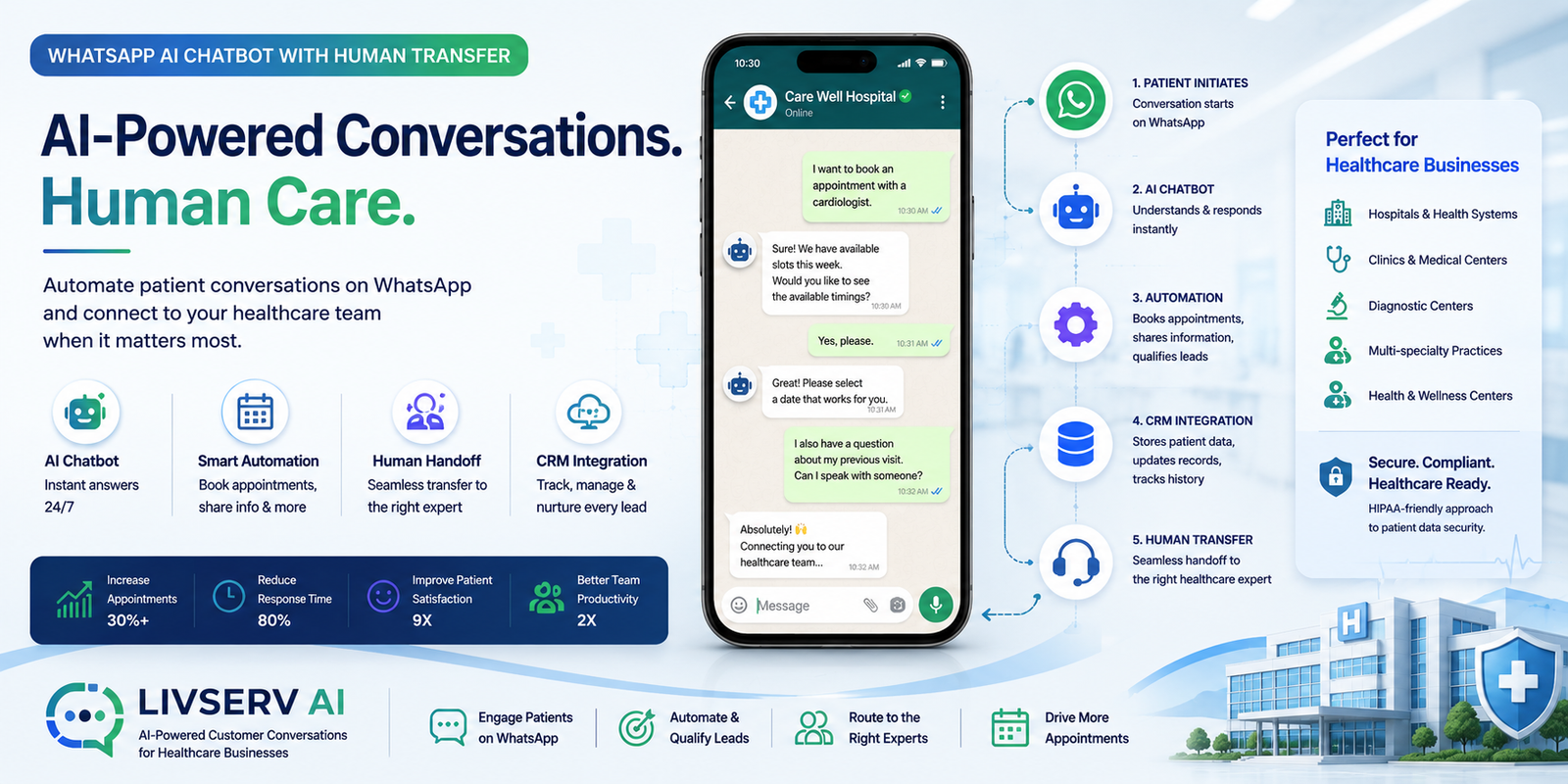
A WhatsApp AI chatbot with human transfer allows AI to handle routine patient conversations while automatically transferring conversations to the appropriate healthcare representative when human assistance is required.
The result is a hybrid patient communication system:
AI Chatbot → Automation → Human Agent
The chatbot handles the initial conversation. Automation manages routine processes. A human representative takes over when the conversation requires personal assistance.
What Is a WhatsApp AI Chatbot with Human Transfer?
A WhatsApp AI chatbot with human transfer is a conversational system that uses AI to communicate with patients through WhatsApp while providing a way to transfer conversations to a human agent.
Instead of forcing patients to choose between a chatbot and a healthcare representative, businesses can use both.
For example:
Patient:
“I want to book an appointment with a cardiologist.”
The AI chatbot can understand the request and guide the patient through appointment booking.
Later, the patient may ask:
Patient:
“I have already visited the hospital and have a question about my previous consultation. Can I speak with someone?”
The chatbot can recognize that the conversation may require human assistance and transfer it to the appropriate representative.
This is the basic concept behind WhatsApp chatbot human transfer.
Why Healthcare Businesses Need Human Handoff
Healthcare communication is different from many other industries.
Patients may contact hospitals and clinics for simple administrative questions, but they can also have complicated requests that require staff intervention.
For example:
- Appointment requests
- Doctor availability
- Department information
- Hospital timings
- Location information
- Billing questions
- Existing patient requests
- Report-related queries
- Complaints
- Service requests
- Follow-up questions
Some of these can be automated.
Others should be handled by trained staff.
That is why healthcare businesses should not think of AI as a replacement for their employees.
Instead, AI can become the first layer of patient communication.
How WhatsApp AI Automation Works for Healthcare
A typical healthcare WhatsApp workflow can look like this:
Patient sends WhatsApp message
↓
AI understands the request
↓
Chatbot provides information
↓
Automation performs the required action
↓
System determines whether human assistance is required
↓
Conversation is transferred to the appropriate agent
This allows healthcare organizations to automate repetitive conversations without completely removing human support.
For example:
Patient:
“What time does the dermatology department open?”
The AI can provide the answer.
Then:
Patient:
“I want to book an appointment.”
The chatbot can guide the patient through the appointment process.
Then:
Patient:
“I need to speak to the hospital about an issue with my previous appointment.”
The system can transfer the conversation to a human representative.
The patient does not need to start a completely new conversation.
WhatsApp AI Chatbot vs Traditional WhatsApp Support
Traditional WhatsApp support usually depends heavily on employees.
A staff member receives a message, reads it, identifies the patient’s requirement, searches for information, responds, and potentially performs another task manually.
When message volume increases, response times can increase as well.
A WhatsApp AI chatbot changes the first stage of that process.
Traditional process
Patient → WhatsApp → Staff Member → Find Information → Respond
AI-assisted process
Patient → WhatsApp → AI → Answer / Automation → Human Agent When Required
The second approach allows healthcare employees to spend less time answering repetitive questions.
What Can a Healthcare WhatsApp AI Chatbot Automate?
A healthcare chatbot can be used for many administrative and customer-service conversations.
Appointment Requests
Patients can initiate appointment conversations through WhatsApp.
The chatbot can ask for relevant information and guide the patient through the available appointment process.
Depending on the integrations and workflow configured by the healthcare organization, appointment information can also be connected to calendars, hospital systems, or CRM platforms.
Doctor Information
Patients frequently ask:
- Which doctors are available?
- Which department should I contact?
- What specialties are available?
- When is a particular doctor available?
The chatbot can provide information from the healthcare organization’s approved knowledge base.
Department Information
A patient may ask:
“Do you have a neurology department?”
The chatbot can provide the relevant information without requiring a staff member to answer manually.
Hospital Locations
For healthcare groups operating multiple branches, patients can ask about:
- Hospital locations
- Clinic locations
- Departments
- Contact information
- Operating hours
- General Patient Support
The chatbot can handle common administrative questions and provide appropriate information.
The key is that the chatbot should stay within the healthcare organization’s approved information and workflows.
When Should the Healthcare Chatbot Transfer to a Human?
The most important part of a WhatsApp AI chatbot with human transfer is knowing when automation should stop.
Human handoff can be triggered in several ways.
1. The patient requests a human
If a patient says:
“I want to speak to someone.”
The system should make human assistance available.
2. The request is outside the chatbot’s capabilities
If the AI cannot confidently handle a request, transferring the conversation can prevent a poor experience.
3. The request requires staff intervention
Certain administrative or operational requests may need to be handled by a hospital employee.
4. The conversation becomes a complaint
Patients with complaints or escalations may require direct assistance from a representative.
5. The patient needs a specific department
The system can route the conversation to the appropriate team when the workflow supports it.
6. The business has defined escalation rules
A healthcare organization can establish specific rules determining which conversations should be transferred.
AI-to-Human Handoff in Healthcare
A good AI to human handoff chatbot should make the transition as seamless as possible.
The biggest mistake is making the patient repeat everything.
Imagine this conversation:
Patient:
“I want to book an appointment with Dr. Sharma.”
AI:
“Sure. What date would you prefer?”
Patient:
“Tomorrow.”
AI:
“Tomorrow is available at 4 PM.”
Patient:
“I also need to discuss an issue regarding my previous appointment. Can I speak with someone?”
The chatbot can initiate a human handoff.
The healthcare representative should ideally receive the conversation context, where the system supports it.
The agent can see that the patient was discussing an appointment and requested assistance.
The agent can then continue the conversation.
This is much better than:
“Hello. How can I help you?”
after the patient has already explained everything.
WhatsApp Human Transfer for Different Healthcare Teams
Human handoff becomes even more valuable when healthcare organizations have multiple teams.
- A hospital might have separate teams for:
- Appointments
- Customer support
- Billing
- Insurance
- Diagnostics
- General inquiries
- Patient relations
- Sales or business
- development
The chatbot can identify the patient’s requirement and route the conversation to the appropriate team when the workflow is configured for it.
For example:
Appointment request
→ Appointment Team
Billing question
→ Billing Team
Insurance question
→ Insurance Team
Complaint
→ Patient Relations
Complex inquiry
→ Appropriate Human Representative
This is more efficient than sending every WhatsApp message to a single employee.
WhatsApp CRM Agent Routing for Healthcare
Connecting WhatsApp conversations with CRM or customer-management systems can provide another layer of automation.
Instead of treating every WhatsApp conversation as an isolated message, businesses can connect customer information and conversation workflows.
A typical process can look like:
↓
AI Chatbot
↓
Identify Customer / Request
↓
CRM
↓
Business Rules
↓
Agent Routing
↓
Human Representative
This can help teams manage conversations more systematically.
For example, if an existing customer contacts the organization, the system may be able to associate the conversation with an existing record when the appropriate integration is available.
The human representative can then continue the conversation with greater context.
Rule-Based Automation + AI for Healthcare
AI is excellent at understanding natural language.
But healthcare organizations often need predictable workflows.
This is where a rule-based engine can work alongside AI.
Consider a patient saying:
“I want to cancel my appointment.”
The AI understands the patient’s intent.
The rule engine can determine what workflow should happen next.
For example:
Intent: Appointment Cancellation
↓
Identify Appointment
↓
Apply Business Rules
↓
Cancel / Create Request
↓
Update System
↓
Notify Patient
↓
Transfer to Human if Required
The AI understands the conversation.
The rules control the workflow.
The human handles exceptions.
This combination creates a more controlled form of conversational automation.
Why a Hybrid Healthcare Chatbot Is Better
A purely automated chatbot can become frustrating when it cannot handle an unusual request.
A purely human support model can become expensive and difficult to scale.
A hybrid model combines both.
AI handles:
- Repetitive questions
- General information
- Patient intent
- Common requests
- Initial conversations
- Automation handles:
- Workflows
- Routing
- CRM updates
- Appointment processes
- Notifications
- Business rules
- Human agents handle:
- Complex requests
- Complaints
- Exceptions
- Requests requiring staff intervention
This gives healthcare businesses a practical model for scaling patient communication.
How Human Handoff Can Improve Patient Experience
Patients don’t necessarily care whether the first response comes from AI or a human.
They care about whether they get the right help quickly.
A good system should therefore make the transition between AI and humans almost invisible.
The patient should experience:
Fast response
Relevant information
Easy escalation
Human assistance when necessary
This is particularly useful when WhatsApp becomes one of the primary communication channels for the organization.
Using WhatsApp AI to Generate More Patient Inquiries
The value of WhatsApp automation isn’t limited to customer support.
Healthcare businesses can also use conversational automation to make it easier for prospective patients to take the next step.
For example:
Visitor sees an advertisement
↓
Clicks WhatsApp
↓
AI answers questions
↓
Patient selects department
↓
AI provides information
↓
Patient requests appointment
↓
Appointment workflow starts
↓
Human representative takes over if necessary
This reduces the number of steps between initial interest and an actual conversation with the healthcare organization.
For marketing campaigns, WhatsApp can therefore become more than a messaging channel.
It can become a conversation-to-action channel.
Example: Healthcare Lead Generation Through WhatsApp
Imagine a hospital running an online campaign for a specialty department.
A potential patient clicks the campaign and starts a WhatsApp conversation.
The AI chatbot can respond:
“Hello. How can we help you today?”
The patient responds:
“I want to know about your orthopedic services.”
The chatbot provides approved information.
The patient asks:
“Can I book an appointment?”
The chatbot guides the patient through the next step.
If the patient wants to speak with a representative, the system can transfer the conversation.
This creates a simple journey:
Campaign → WhatsApp → AI → Appointment → Human Assistance
The organization doesn’t have to rely on a salesperson or support employee to answer every initial question manually.
What Makes a Good WhatsApp AI Chatbot for Healthcare?
When evaluating a healthcare WhatsApp chatbot, businesses should look beyond the ability to generate AI responses.
Important capabilities include:
AI conversation handling
The system should understand natural-language questions rather than relying only on exact predefined phrases.
Human handoff
Patients should be able to reach a human when necessary.
Rule-based workflows
Businesses should be able to control important processes using defined rules.
CRM integration
The chatbot should be able to work with relevant customer-management systems where integrations are available.
WhatsApp automation
The system should support the organization’s WhatsApp communication workflows.
Conversation context
Human agents should receive useful conversation information during handoff where supported.
Agent routing
Conversations should be directed to the appropriate team or representative according to configured workflows.
Knowledge management
The AI should use the organization’s approved business information instead of relying on generic answers.
AI Should Assist Healthcare Staff, Not Replace Them
Healthcare is a human-centered industry.
Patients may be comfortable asking an AI about general information, but they may still want to speak with a real person when the situation becomes complicated.
That doesn’t make AI less valuable.
It makes human handoff more important.
The most effective approach is to let AI handle the volume while allowing healthcare employees to focus on conversations where their involvement provides greater value.
Instead of replacing the human layer, AI can reduce the repetitive workload around it.
The Future of WhatsApp Patient Communication
Healthcare communication is moving toward conversational experiences where patients don’t have to navigate complicated websites or wait for a staff member to respond to simple questions.
A patient can start a conversation on WhatsApp and potentially move through several stages:
Ask a question
↓
Get an AI response
↓
Request information
↓
Start an appointment workflow
↓
Connect with a CRM
↓
Get routed to the right team
↓
Speak with a human when needed
This creates a connected patient communication journey rather than a collection of disconnected tools.
Conclusion
A WhatsApp AI chatbot with human transfer gives healthcare organizations a practical way to combine automation with human support.
AI can handle the first level of communication.
Rule-based automation can control business workflows.
CRM integrations can connect conversations with customer information.
WhatsApp provides a familiar communication channel.
And human agents remain available when patients need personal assistance.
The objective isn’t to automate every conversation.
The objective is to automate the right conversations and transfer the right conversations to the right people.
For healthcare businesses, this can create a scalable communication model that supports both patient service and lead generation.
With a platform such as Livserv AI, businesses can bring together AI chatbot conversations, rule-based automation, WhatsApp, CRM workflows, and human-agent handoff into a connected conversational experience.
AI handles the routine. Automation handles the process. Humans handle what matters most.