Customers don’t always want to talk to a chatbot.
Sometimes they need a quick answer. Sometimes they want to book an appointment. Sometimes they have a complex problem that requires a real person.
This is where a **chatbot with live agent handoff** becomes more useful than a chatbot that simply answers questions.
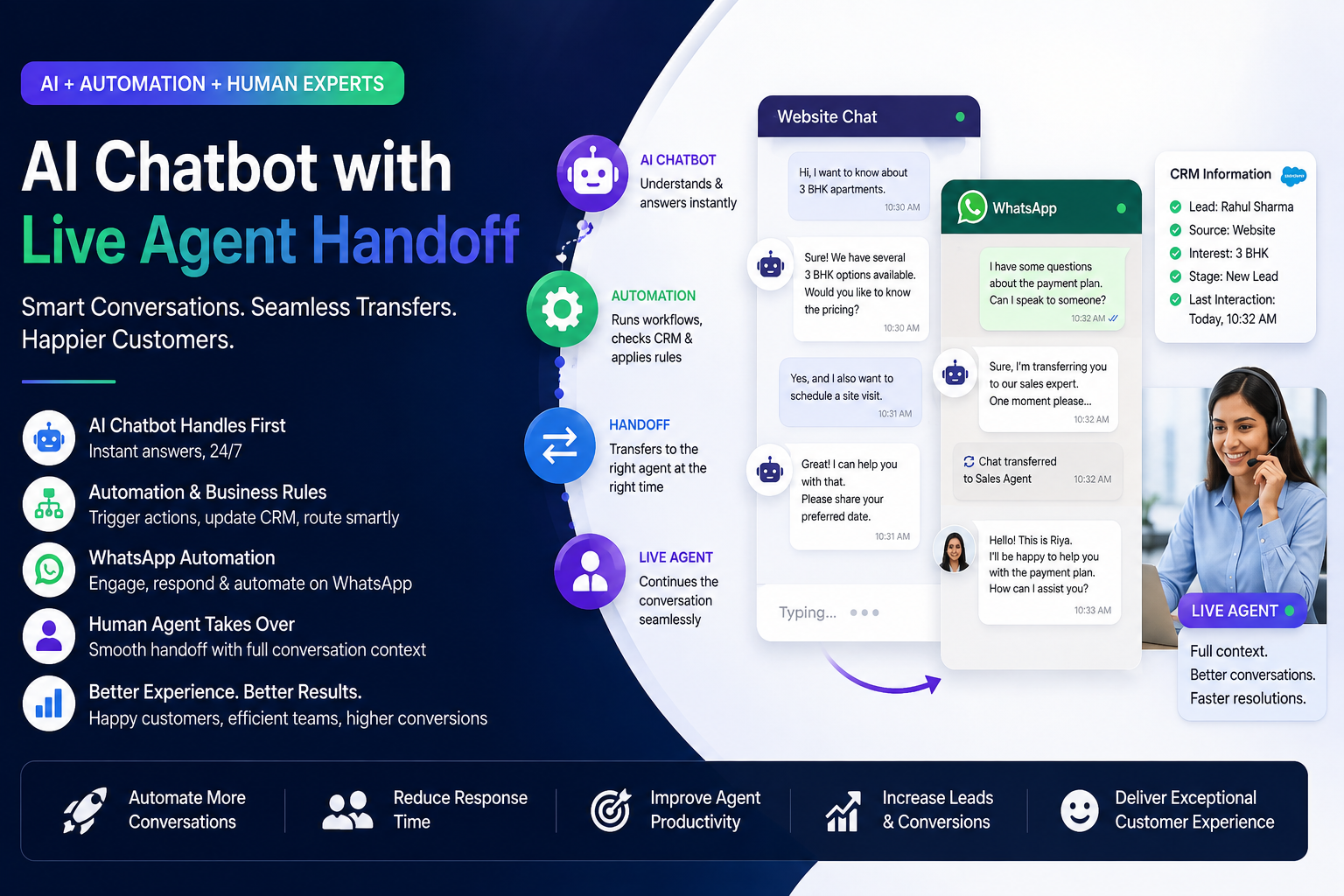
Modern businesses can combine AI, automation, business rules, WhatsApp, CRM systems, and human agents into one conversational workflow. The AI handles routine conversations, automation executes predefined actions, and human agents take over when a conversation requires personal attention.
This approach is becoming especially valuable for businesses managing large numbers of customer conversations across websites and WhatsApp.
A chatbot with live agent handoff is an AI-powered conversational system that can automatically transfer a customer from a bot to a human representative when necessary.
Instead of forcing the customer to continue talking to the AI, the system recognizes situations where human intervention is appropriate.
A typical conversation can work like this:
**Customer → AI Chatbot → Intent Detection → Business Rules → Automation → Human Agent When Required**
For example, a customer might ask:
- “What are the available apartments?”
The AI can answer the question automatically.
The customer may then ask:
- I have already paid the booking amount. Can you check my payment status?”
The chatbot can retrieve information from the CRM if the required integration is available.
But if the customer says:
- There is an issue with my payment. I want to speak to someone.”
The conversation can be transferred to a human representative.
This is the basic concept behind **AI to human handoff chatbot** systems.
Why Do Businesses Need AI-to-Human Handoff?
Traditional chatbots generally follow one of two approaches.
- The first is a simple rule-based bot that provides predefined answers.
- The second is an AI chatbot that understands natural language and generates responses.
- Both approaches have limitations when used independently.
–>A rule-based chatbot can provide predictable workflows, but it may struggle when customers ask questions outside predefined paths.
–>An AI chatbot can understand a much wider range of questions, but businesses may still need strict rules for sensitive workflows, escalation, routing, and operational processes.
–>A hybrid approach combines the strengths of both.
1) AI can handle:
* Natural-language questions
* Product information
* Frequently asked questions
* Customer intent
* General support
* Information requests
* Conversation context
2) Rules can control:
* Lead routing
* Customer segmentation
* Escalation
* Business processes
* Agent assignment
* CRM updates
* Appointment workflows
* Support workflows
3) Human agents can handle:
* Complex problems
* Negotiations
* Complaints
* High-value customers
* Sensitive requests
* Exceptions
* Sales conversations
* Issues requiring human judgment
This creates a more practical customer service model.
- # How AI to Human Handoff Works
A modern chatbot agent transfer feature does not have to mean simply displaying a button that says “Talk to an agent.”
The transfer can be triggered automatically based on conversation context, customer intent, business rules, or a specific customer request.
A simplified workflow looks like this:
**Customer starts conversation**
↓
**AI understands the request**
↓
**AI provides information or performs an automated action**
↓
**System evaluates whether human intervention is required**
↓
**Conversation is routed to the appropriate agent**
↓
**Human agent continues the conversation**
The important part is that the customer should not have to repeat everything they have already explained.
The agent should receive the conversation context whenever the platform supports it.
For example:
> Customer: “I want to book a site visit for a 3-bedroom apartment.”
The chatbot collects the required information.
> Customer: “I also have a question about the payment plan.”
If the question requires a salesperson, the system can transfer the conversation to the appropriate representative.
The agent can then continue from the existing conversation rather than asking:
> “How can I help you?”
This makes the transition much more natural.
- WhatsApp Bot Human Transfer
WhatsApp has become an important customer communication channel for many businesses.
Customers often start conversations through WhatsApp because they already use it every day.
A business can therefore combine a WhatsApp bot with human transfer functionality.
A typical **WhatsApp automation with human transfer** workflow can look like:
**Customer sends WhatsApp message**
↓
**WhatsApp bot understands the request**
↓
**Bot provides information**
↓
**Customer requests human assistance**
↓
**System identifies the appropriate agent**
↓
**Conversation is transferred**
↓
**Human representative continues the conversation**
For example:
> “I want to know whether my booking has been confirmed.”
The WhatsApp bot can potentially retrieve the relevant information through connected business systems.
But if the customer says:
> “There is a problem with my booking and I need someone to call me.”
The conversation can be escalated to an appropriate team member.
This creates a combination of **automation and human support**, instead of forcing customers into an entirely automated experience.
- WhatsApp Bot vs WhatsApp Bot with Human Transfer
There is a major difference between basic WhatsApp automation and a system designed for human escalation.
### Basic WhatsApp bot
Customer → Bot → Answer
### WhatsApp bot with human transfer
Customer → Bot → Understand Intent → Automate → Escalate → Human Agent
The second model is more suitable for businesses where customer conversations can become complex.
For example, a real estate company may receive:
* Property inquiries
* Pricing questions
* Site visit requests
* Booking questions
* Payment questions
* Construction updates
* Complaints
* Existing customer requests
Not every conversation should follow the same automation path.
Some can be completed by AI.
Some require CRM information.
Some require a predefined workflow.
Others require a salesperson or support representative.
- WhatsApp CRM Agent Routing
The next step is connecting the conversation with the company’s CRM.
With **WhatsApp CRM agent routing**, customer conversations can potentially be connected to CRM information and routing workflows.
Instead of treating WhatsApp as an isolated communication channel, the business can connect the conversation to its existing customer-management process.
For example:
**WhatsApp**
↓
**AI Bot**
↓
**Customer Identification**
↓
**CRM**
↓
**Conversation Context**
↓
**Agent Routing**
↓
**Sales / Support Representative**
This can help businesses reduce manual work and improve response management.
For example, a company may have separate teams for:
* New sales inquiries
* Existing customers
* Technical support
* Billing
* Site visits
* Customer service
Instead of sending every conversation to the same representative, routing rules can determine where the conversation should go.
- What Is a Hybrid AI Chatbot Platform?
A **hybrid AI chatbot platform** combines multiple approaches to conversational automation.
Rather than depending entirely on AI or entirely on predefined rules, the platform can use both.
A typical hybrid architecture can include:
### 1. AI Layer
Understands natural language and customer intent.
### 2. Rule Engine
Controls business-specific conditions and workflows.
### 3. Automation Layer
Performs actions such as creating records, booking appointments, updating systems, or triggering workflows.
### 4. Integration Layer
Connects the chatbot with CRM, WhatsApp, calendars, websites, helpdesk systems, and other business applications.
### 5. Human Agent Layer
Allows conversations to be transferred to employees when automation is no longer appropriate.
This model provides more control than relying on AI alone.
- Why Rule-Based Automation Still Matters
AI is powerful, but businesses still need predictable processes.
Consider a customer asking:
> “Can I cancel my booking?”
A business may have specific rules around cancellation.
The chatbot should not simply generate an answer based on general knowledge.
Instead, the conversation can follow a controlled workflow.
For example:
**Customer Request**
↓
**Identify Customer**
↓
**Check Booking**
↓
**Check Applicable Rules**
↓
**Create Support Request**
↓
**Notify Appropriate Team**
↓
**Transfer to Human Agent if Required**
This is one reason hybrid conversational systems are useful.
AI can understand what the customer is asking.
Rules can determine what the business should do.
Humans can handle exceptions.
- When Should a Chatbot Transfer a Customer to a Human?
A chatbot does not need to transfer every customer.
The objective should be to automate routine conversations while making human assistance available when it adds value.
Common handoff situations include:
### Customer explicitly requests an agent
For example:
> “I want to speak to someone.”
The system should not force the customer to continue with the bot.
### Complex customer problem
If the conversation involves a complicated issue that requires human judgment, escalation may be appropriate.
### Complaint or escalation
Customers dealing with serious complaints may benefit from human assistance.
### High-value sales opportunity
A customer showing strong buying intent may be routed to a salesperson.
### Failed automation
If the chatbot cannot confidently handle a request, transferring the conversation can prevent a frustrating customer experience.
### Sensitive information
Some requests may require human verification or intervention.
### Business-specific conditions
Rules can determine when a conversation must be transferred.
- How Bot-to-Live-Rep Routing Software Works
The basic objective of **bot to live rep routing software** is to move conversations from automated systems to the appropriate human representative.
Instead of manually monitoring every conversation, businesses can establish routing rules.
For example:
**New Property Inquiry**
→ Sales Team
**Existing Customer**
→ Customer Support
**Payment Issue**
→ Finance Team
**Site Visit Request**
→ Sales Executive
**Technical Issue**
→ Support Team
The exact routing logic depends on the organization’s processes.
A sophisticated system can combine customer information, conversation context, intent, business rules, and CRM information to determine the appropriate destination.
- AI Chatbot with CRM Agent Escalation
Connecting the chatbot to a CRM can make human escalation more useful.
Consider a returning customer.
The chatbot may identify the customer and access available CRM information.
Instead of the agent starting from scratch, the system can provide context such as:
* Customer information
* Previous conversations
* Lead status
* Existing requests
* Appointment information
* Relevant CRM records
The agent can then focus on solving the customer’s problem rather than collecting basic information again.
This is the practical value of an **AI chatbot with CRM agent escalation**.
The chatbot becomes the first layer of interaction, while the CRM provides business context and the human agent handles conversations that require personal attention.
Example: Real Estate AI Chatbot with Human Handoff
Consider a property developer receiving hundreds of conversations every day.
A potential buyer visits the website and asks:
> “Do you have 3 BHK apartments?”
The AI chatbot answers the question.
The buyer then asks:
> “What is the price?”
The chatbot provides the available information.
The customer continues:
> “Can I schedule a site visit tomorrow?”
The chatbot starts the site-visit workflow.
The customer then says:
> “I have a few questions about the payment plan. Can I speak to a sales executive?”
This is where human handoff becomes valuable.
The conversation can move from:
**AI Chatbot**
to
**Sales Representative**
without forcing the customer to restart the conversation.
The result is a blended experience:
**AI for speed**
*
**Automation for efficiency**
*
**Human agents for complex conversations**
- What Happens After the Human Agent Takes Over?
A good handoff should not simply transfer the customer.
The system should preserve the conversation context wherever supported.
The human agent can then understand:
* What the customer asked
* What information was already provided
* What the customer is trying to accomplish
* Which workflow was triggered
* Why the conversation was escalated
This reduces repetitive questions and creates a smoother customer experience.
The ideal experience is:
> **Customer talks to AI → AI understands → automation handles routine tasks → human takes over when needed.**
The customer should experience this as one continuous conversation.
- Benefits of AI and Human Agent Collaboration
A hybrid conversational approach can provide several operational benefits.
## Faster initial responses
AI can respond immediately to routine questions instead of making customers wait for an employee.
## Reduced repetitive work
Employees don’t need to answer the same basic questions repeatedly.
## Better agent productivity
Human representatives can spend more time on conversations that actually require their involvement.
## Better customer experience
Customers can receive automated answers when appropriate while still having access to a human representative.
## More controlled automation
Rules can control important business processes instead of leaving everything to AI-generated responses.
## Better use of CRM data
Connected systems can provide agents and customers with relevant information during conversations.
- The Future of Customer Conversations Is Hybrid
Businesses don’t have to choose between a chatbot and a human support team.
The better model is to connect them.
A modern conversational platform can allow AI to handle routine customer interactions while business rules control important workflows and human agents step in when necessary.
This is particularly useful for businesses operating across websites, WhatsApp, CRM systems, and multiple customer service teams.
The objective isn’t simply to create a chatbot that talks.
The objective is to create a system that can **understand conversations, perform actions, route customers, access business information, and involve human employees at the right moment.**
That’s the real value of combining AI with automation and human support.
- Conclusion
A **chatbot with live agent handoff** provides a practical middle ground between fully automated customer service and completely manual support.
With the right architecture, businesses can combine:
**AI chatbot + rule-based automation + CRM + WhatsApp + agent routing + human support**
into one customer conversation.
Instead of asking whether AI or humans should handle customer interactions, businesses can ask a better question:
> **Which parts of the customer journey should AI automate, and where should a human take over?**
That is where hybrid conversational automation becomes valuable.
For businesses looking to automate customer conversations without removing human support, a platform such as **Livserv AI** can bring AI conversations, business rules, CRM workflows, WhatsApp automation, and human-agent escalation into a connected customer communication process.